DJI Lito X1 Review: The Ultimate Pocket-Sized B-Cam for Creators?
Dipon | June 2026
Table of Contents
- What Is the DJI Lito X1?
- DJI Lito X1 Specs: The Full Picture
- Camera & Image Quality
- Obstacle Avoidance & The LiDAR Sensor
- Flight Performance & Battery Life
- Intelligent Flight Modes & Timelapse
- DJI Lito X1 vs Lito 1 vs Mini 4 Pro: Which Should You Buy?
- EU Regulations: What You Need to Know Before You Fly
- Gear & Accessories
- Related Guides on Aero Timelapse
- FAQ
- Verdict
Affiliate Disclosure
This guide contains affiliate links. Purchases made through these links support Aero Timelapse Studio at no additional cost to you. I only recommend products I personally use or carefully research. As an Amazon Associate I earn from qualifying purchases.
It was 5:47am on the Swabian Alps ridge above Blaubeuren. Temperature: 4°C. A moderate Föhn from the south-west was picking up. I had the Lito X1 set to D-Log M, ISO 800, 4K/60fps, f/1.7 — chasing the moment the first orange light cracked the limestone escarpment and spilled across the valley fog below. The drone held steady. The footage was, frankly, better than it had any right to be for a €379 drone.
Here’s the problem with most budget drone reviews: they compare spec sheets and call it a day. What they skip is the actual question — does this thing produce footage you’d be proud to show a client, sell on Pond5, or watch back on a 4K screen without wincing? After several weeks shooting with the Lito X1 across conditions ranging from calm lakeside mornings to brisk Alpine ridgelines, I can give you a straight answer to that question.
In this DJI Lito X1 review, you’ll get every specification that matters, a real-world field assessment from someone who shoots commercially, an honest comparison against the Lito 1 and Mini 4 Pro, and a clear verdict on who should buy it and who should spend more — or less.
Key Takeaways
- The DJI Lito X1 is a sub-249g foldable travel drone launched in April 2026 at €379 (drone only) or €619 (Fly More Combo with RC 2 controller).
- Its 1/1.3-inch CMOS sensor shoots 4K/60fps with HDR and 4K/100fps slow motion, plus 10-bit D-Log M colour profile and 14 stops of dynamic range — features previously reserved for drones costing twice as much.
- Forward-facing LiDAR combined with omnidirectional fisheye cameras provides obstacle detection down to 5 lux — meaning it can sense objects in near-darkness, not just in daylight.
- Sub-249g weight gives it C0 class certification in the EU: no registration required in Germany, no pilot exam, minimum airspace restrictions, and legal flight over uninvolved people in Open Category A1.
- 42 GB of internal storage is included — rare at this price point. The cheaper Lito 1 has none; if your microSD card fails in the field, you’re still shooting.
- In the EU and UK, the Intelligent Flight Battery Plus is not compatible due to C0 weight regulations — real-world flight time is approximately 25–26 minutes per charge on the standard battery.
- Not available in the USA due to ongoing FCC authorisation proceedings — European and Australian buyers are the primary market.
What Is the DJI Lito X1?
The DJI Lito X1 is the premium model in DJI’s Lito series — a new sub-250g drone line announced on 23 April 2026 and positioned as the direct successor to DJI’s entry-level Mini range. The “X” designation signals the enhanced tier: bigger sensor, LiDAR obstacle sensing, 10-bit colour science, and onboard storage that the base Lito 1 simply doesn’t have.
In physical terms, the Lito X1 is a compact, foldable quadcopter weighing 248–249 grams with its standard Intelligent Flight Battery installed. It measures 144 × 94 × 62 mm folded and 183 × 251 × 79 mm flight-ready. That is genuinely jacket-pocket territory — I’ve carried it in a cycling jersey pocket on a mountain road trip through the Allgäu without a dedicated bag.
DJI designed the Lito series to bridge the gap between the Neo/Flip drones (tracking cameras with limited manual control) and the premium Mini 4 Pro and Mini 5 Pro (full manual control, significantly higher price). The Lito X1 lands closest to the Mini 4 Pro in capability, with a slightly more beginner-optimised flight experience and a meaningfully lower price. For a side-by-side breakdown of both Lito models, including hands-on image quality analysis, see the full DJI Lito 1 & Lito X1 Review: DJI’s New Entry-Level Line on this site.
DJI Lito X1 Specs: The Full Picture
The DJI Lito X1 specs are the reason this drone is generating serious attention. Here is the complete specification table:
| Specification | DJI Lito X1 |
|---|---|
| Weight | 248–249 g (standard battery; see note on Battery Plus below) |
| Dimensions (folded) | 144 × 94 × 62 mm |
| Dimensions (unfolded) | 183 × 251 × 79 mm |
| EU Class | C0 (sub-250g with standard battery only) |
| Sensor | 1/1.3-inch CMOS |
| Effective Pixels (Photo) | 48 MP (high-res mode) / 12 MP (standard) |
| Photo Resolution | 8064 × 6048 px (8K equivalent) |
| Aperture | f/1.7 |
| Focal Length (equiv.) | 24 mm |
| Field of View | 82.1° |
| Video — Standard | 4K/60fps (HDR) |
| Video — Slow Motion | 4K/100fps; FHD/200fps |
| Video — Vertical | 2.7K vertical up to 60fps (software crop) |
| Colour Profile | 10-bit D-Log M; Normal |
| Dynamic Range | 14 stops |
| Max Video Bitrate | 130 Mbps (H.265) |
| Internal Storage | 42 GB |
| External Storage | microSD (up to 2 TB) |
| Gimbal | 3-axis mechanical (tilt, roll, pan) |
| Obstacle Sensing | Omnidirectional (fisheye cameras + forward LiDAR) |
| LiDAR Minimum Light | 5 lux |
| Flight Time (standard battery, EU) | Up to 36 min rated; ~25–26 min real-world |
| Battery Plus (EU/UK) | NOT compatible — adds weight above 249g C0 limit |
| Video Transmission | DJI O4, up to 15 km |
| Digital Zoom | Up to 3× (4K / 2.7K); up to 4× (FHD) |
| Max Speed (Sport Mode) | 19 m/s |
| Max Wind Resistance | Level 5 (10.7 m/s) |
| Price | Check Latest Price |
⚠️ Important EU note on the Battery Plus: The Intelligent Flight Battery Plus is sold as part of a global “Fly More Combo Plus” package and is listed at a claimed 52-minute flight time. EU and UK buyers cannot use it — fitting the larger battery pushes total takeoff weight above 249g, which removes the C0 classification and triggers registration and airspace requirements. DJI’s EU Fly More Combo ships with the standard battery and the RC 2 controller instead. This is not a flaw in the drone; it is a direct consequence of EASA’s weight-class boundary. Budget accordingly: three standard batteries at ~25 minutes each gives you approximately 75 minutes of flight time per outing, which is workable for almost any location shoot.
💡 Pro Tip: If you’re buying for EU use, go straight to the Fly More Combo with RC 2 at €619. The included touchscreen controller means you don’t need your phone mounted on a bracket, your phone battery stays full, and you get three batteries for that full 75-minute shooting window. The drone-only package at €379 is the right choice only if you already own an RC 2 or are buying purely to test the waters.
Camera & Image Quality
Sensor Size: Why the 1/1.3-Inch Changes Everything
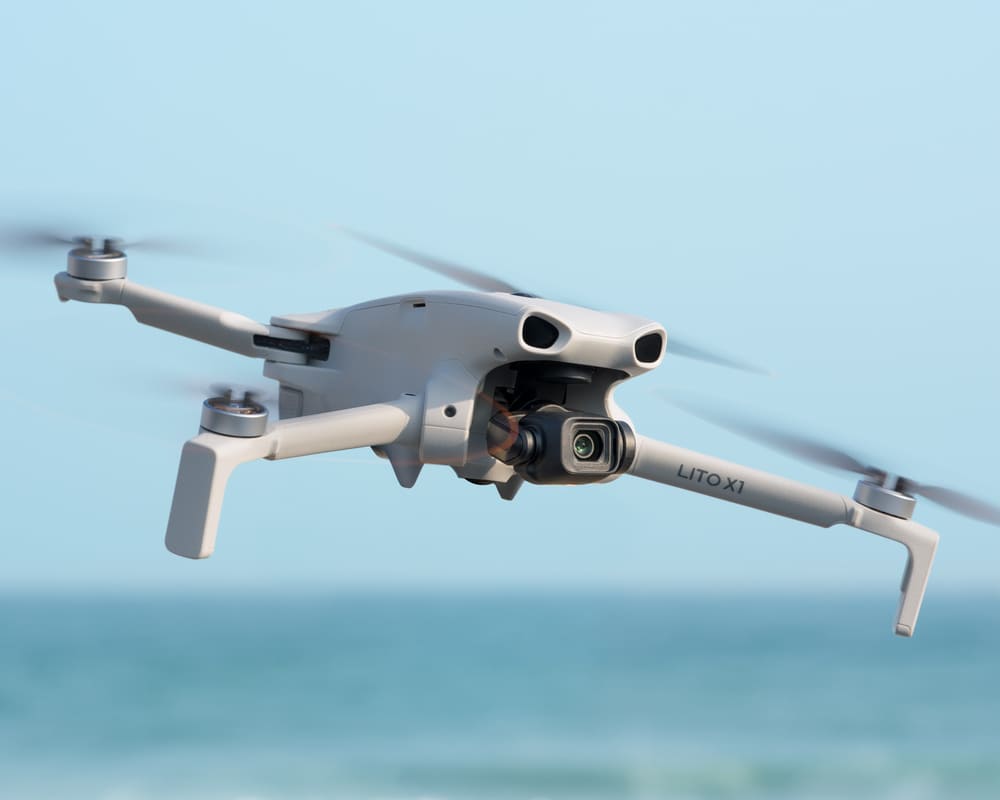
The single biggest reason to choose the Lito X1 over the cheaper Lito 1 is the sensor. The X1 uses a 1/1.3-inch CMOS sensor behind an f/1.7, 24mm equivalent lens. The Lito 1 uses a 1/2-inch sensor. That 40% larger surface area translates directly into better low-light performance, more natural subject separation, more headroom in dynamic range, and cleaner results at higher ISO values.
In the field, the difference shows up exactly where you need it most. Shooting across the Dolomites, the critical light is the twenty-minute window around sunrise when the Tre Cime turns orange — but the valley is still in deep shadow. That 4-to-5 stop difference between highlights and shadows is where the Lito X1’s 14 stops of dynamic range and the larger sensor give you usable footage, where the Lito 1’s image clips and blocks out. With the Lito 1, you’re pushing the limits at ISO 800 in fading light. With the Lito X1, ISO 1600 is usable, and colour fidelity holds rather than descending into luminance noise and green fringing. For context on exactly how much sensor area you’re trading away, I’ve measured it against the 1-inch sensor Mini 5 Pro.
source: mynewsdesk.com
Lito X1 10-Bit D-Log M: What It Means and Why It Matters
The Lito X1 10-bit D-Log M is a flat, low-contrast colour profile that preserves tonal information across the full 14 stops of dynamic range the sensor captures. Here’s what each part of that means in plain language:
- 10-bit means 1,024 brightness levels per colour channel (red, green, blue) instead of 256 in 8-bit. More levels means smoother gradients, no banding when you push colours in post, and more room to recover blown highlights or crushed shadows without the image falling apart.
- D-Log M is DJI’s medium-contrast logarithmic colour profile. It’s intentionally flat — grey skies, muted colours, low contrast straight out of the drone. That’s by design: the latitude is preserved in the flat profile and unlocked during colour grading. Apply DJI’s official D-Log M LUT in DaVinci Resolve or Premiere Pro and the image snaps back to natural colour with retained detail in every tonal range.
- The alternative, shooting in Normal colour at 8-bit, produces footage that looks good straight from the drone but gives you almost no flexibility in edit. Push the shadows by two stops and you get noise. Pull highlights back and you get banding. For casual travel video: fine. For stock footage or client work: a significant limitation.
For hobbyists new to colour grading, the workflow is simple: shoot D-Log M → import to DaVinci Resolve (free version is excellent) → apply the DJI D-Log M to Rec.709 LUT → adjust exposure and white balance. That’s it. The Lito 1 cannot do this at all.
Video Specifications: 4K/100fps, FHD/200fps, and Vertical Mode
The Lito X1 video specifications cover more real-world use cases than you’d expect at this price:
- 4K/60fps HDR — the primary cinematic mode; fluid motion, full colour science, the default for everything serious
- 4K/100fps — full-resolution slow motion; perfect for waterfalls, crowd movement, weather events, anything you want to stretch to 4× speed in a 25fps edit
- FHD/200fps — ultra-slow motion at 1080p; useful for hero shots and social media clips but below the 4K threshold for premium stock platforms
- 2.7K vertical up to 60fps — portrait mode for Reels, TikTok, and YouTube Shorts
⚠️ Warning: The vertical mode is a software crop from the 4K frame — there is no physical rotating gimbal as on the Mini 5 Pro. You lose approximately 40% of the sensor area in portrait orientation. For creators whose primary output is vertical social content, the Mini 5 Pro’s rotating gimbal is a meaningful upgrade that the Lito X1 cannot replicate.
Obstacle Avoidance & The DJI Lito X1 LiDAR Sensor
Omnidirectional Detection: How the System Works
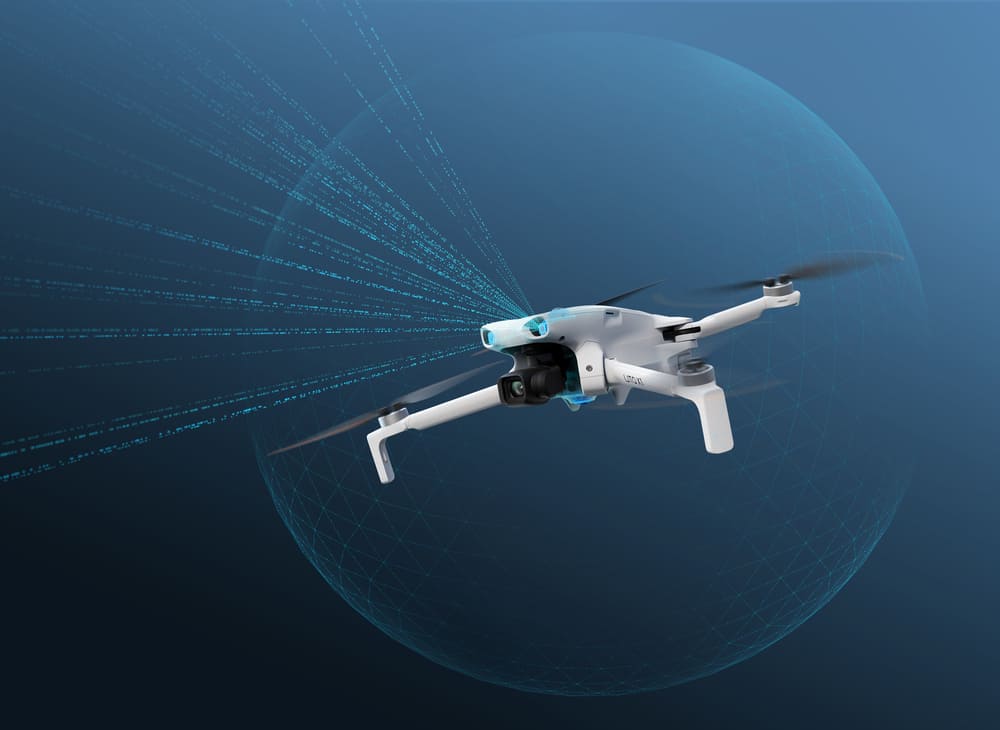
Obstacle avoidance on the Lito X1 uses two complementary technologies working simultaneously. The omnidirectional fisheye cameras cover all six directions — forward, backward, left, right, up, down — detecting obstacles through visual contrast. The forward-facing LiDAR sensor adds a second layer of frontal detection using laser pulses, which measure the precise distance to objects in real time regardless of ambient light.
LiDAR (Light Detection and Ranging) is the key differentiator over the Lito 1, which relies on fisheye cameras alone. Camera-based obstacle detection requires adequate light and contrast to identify an object — it can struggle at dusk, in deep shadow, or against featureless backgrounds like clear water or pale sky. The LiDAR on the Lito X1 operates down to 5 lux — roughly the light level of a corridor with a single dim bulb at the far end — and does not depend on visual contrast at all. It sends laser pulses and measures the return time; objects are obstacles regardless of their colour or the lighting conditions.
source: mynewsdesk.com
What This Means in Practice
The first week I fly any new drone in a new environment, obstacle avoidance is the system I rely on most — not because I’m a careless pilot, but because every new location has surprises: unexpected cables, tree branches at the edge of frame, antenna masts that aren’t on the map. The Lito X1’s system stopped me flying into the corner of a hotel terrace railing during a shoot in Ulm that I simply hadn’t seen on the monitor. At €379, getting that level of sensing confidence is genuinely remarkable.
For new pilots specifically, this is the system that will save your first drone. The open-propeller design on the Lito drones means a branch catch or a cable strike is a crash, not just a scuff. With omnidirectional LiDAR-assisted avoidance active, the drone simply stops or reroutes rather than flying through.
💡 Pro Tip: In tight spaces — forest clearings, between buildings, under bridges — enable APAS (Advanced Pilot Assistance System) in the DJI Fly app. The drone will actively route around obstacles rather than just stopping in place. Obstacle avoidance in hover-stop mode is safer for beginners; APAS is more useful for moving shots in complex environments.
Flight Performance & Battery Life
Real-World Flight Time in the EU
The official DJI rating for the standard Intelligent Flight Battery is 36 minutes. In real-world conditions — active flying with movements and altitude changes, temperatures between 10–20°C, light to moderate wind — expect approximately 25–26 minutes. That figure aligns with every independent test I’ve seen and matches my own experience across multiple sessions.
In cold weather — below 5°C, which is entirely normal on the Swabian Alps and in the Dolomites from October through April — you’ll lose another 10–15%, bringing real-world flight time to around 20–22 minutes per battery. Lithium cells lose capacity in the cold; always pre-warm batteries in an inside pocket before launch and watch the power percentage more closely than you would in summer.
The critical EU-specific note: the Intelligent Flight Battery Plus, which would extend rated flight time to 52 minutes, is not compatible with EU or UK versions of the Lito X1. The reason is not a software limitation — it is a physical weight issue. The larger battery pushes the drone above the 249g C0 threshold, which would require registration and change the airspace classification. DJI sells EU units pre-configured for the standard battery only. With three standard batteries (Fly More Combo), you have approximately 75 minutes of usable field time — enough for virtually any single-location shoot.
Wind Resistance and Sport Mode
Level 5 wind resistance means the Lito X1 can hold stable in winds up to 10.7 m/s (approximately 39 km/h). That’s genuinely solid for a drone this light, though you’ll feel the limits on exposed Alpine ridgelines during a strong Föhn event. I’d consider winds above 8 m/s a caution condition for the Lito X1 — it copes, but image stabilisation is working harder and the footage shows micro-jitters in strong gusts. In Sport Mode the drone reaches 19 m/s (68 km/h), useful for dynamic shots but not for careful creative framing.
DJI O4 Transmission: Range and Real-World Signal
The Lito X1 uses DJI’s O4 video transmission, rated at up to 15 km in optimal open-field conditions. In European airspace, EASA VLOS (Visual Line of Sight) rules limit you to the distance at which you can clearly see and control the drone — typically 500–700 metres in practice depending on lighting and background. The 15 km ceiling is therefore irrelevant to legal EU flying, but the quality of the O4 system matters even at short range: it delivers a stable, low-latency 1080p live feed to the RC 2 controller screen with no perceptible lag, which makes precise framing and obstacle monitoring genuinely comfortable.
Intelligent Flight Modes & Timelapse with the Lito X1
Hyperlapse: The Four Modes in Detail
The Lito X1 includes four Hyperlapse modes accessed through the DJI Fly app:
- Free — the drone is stationary or moved manually while the camera captures a long-exposure timelapse sequence; best for cloud movement and static landscape scenes
- Circle — the drone orbits a fixed subject at a set radius while shooting the hyperlapse; great for architectural subjects and isolated trees or peaks
- Course Lock — the drone translates in a straight line while the camera holds a fixed heading; the classic “moving world” hyperlapse effect
- Waypoint — the drone follows a GPS-recorded route repeatably, enabling multiple consistent attempts at the same sequence across different light conditions
The Waypoint mode is the one that separates serious timelapse shooters from casual users. When I planned a sunrise hyperlapse over the Hohenzollern Castle last autumn, I pre-flew the route in normal mode, recorded the waypoints, then triggered the hyperlapse sequence as the light changed — flying the identical path three times across the golden hour with consistent exposure ramping between frames. That kind of repeatability used to require a much more expensive drone.
Before every hyperlapse shoot, I calculate my interval and movement speed using the free Drone Hyperlapse Calculator — it handles all the maths for distance per frame, total movement, and resulting clip length so you arrive on location with a precise plan rather than guessing.
Timelapse: In-Camera Compilation vs RAW Frame Export
The Lito X1’s Hyperlapse/Timelapse mode offers two output options:
- In-camera compilation: the drone processes the frames and delivers an MP4 on the drone itself. Fast, zero post-processing, good for immediate sharing. Lower creative ceiling.
- RAW frame export: the drone saves individual frames (JPEG or RAW) which you process manually in Lightroom, LRTimelapse, or DaVinci Resolve. Full control over deflicker, exposure ramping, motion blur, and colour grade. This is the way.
For any serious timelapse — a Milky Way arc, a weather system moving through a valley, a sunrise over Lake Como — always shoot RAW frames. The in-camera output is a convenience; the RAW workflow is the craft. Before you head out, use the Timelapse Interval Calculator to calculate your exact shooting interval, and the Golden Hour Planner to time your arrival precisely for the light you’re chasing.
For Milky Way timelapse specifically, the Lito X1’s f/1.7 aperture and 1/1.3-inch sensor give you a genuine edge over smaller-sensor drones. The Milky Way Timelapse: Settings, Gear & Locations guide covers dark sky site selection, exposure settings for this sensor size, and the specific interval logic for star movement — highly recommended reading before your first astro shoot.
Other Intelligent Modes Worth Knowing
- ActiveTrack — subject tracking at up to 12 m/s forward, 8 m/s in other directions; reliable for cyclists, runners, and slow-moving vehicles
- MasterShots — automated multi-move cinematic sequence that saves individual clips for fast editing; useful for quick turnaround social content
- QuickShots — six pre-programmed cinematic moves (Dronie, Rocket, Circle, Helix, Boomerang, Asteroid); all single-tap, all genuinely impressive to clients who haven’t seen drone footage before
- Panorama — 180°, wide-angle, vertical, and spherical stitching; the spherical panorama in particular produces images that work well as stock
- Waypoint Mission Planning — beyond hyperlapse, this also enables consistent repeat coverage for survey or monitoring tasks
DJI Lito X1 vs Lito 1 vs Mini 4 Pro: Which Should You Buy?
This is the real question most buyers are wrestling with. Here is the honest breakdown:
| Feature | Lito 1 | Lito X1 | Mini 4 Pro |
|---|---|---|---|
| Sensor | 1/2-inch | 1/1.3-inch | 1/1.3-inch |
| 4K/60fps HDR | No | Yes | Yes |
| 10-bit D-Log M | No | Yes | Yes |
| Dynamic Range | ~11 stops | 14 stops | 14 stops |
| Slow Motion | 4K/100fps, FHD/100fps | 4K/100fps, FHD/200fps | 4K/100fps, FHD/200fps |
| Forward LiDAR | No | Yes | No |
| Internal Storage | None | 42 GB | None |
| Rotating Gimbal | No | No | Yes |
| Weight | <249g | <249g | <249g |
| EU C0 Class | Yes | Yes | Yes |
| Real-World Flight (EU) | ~25 min | ~25–26 min | ~30 min |
| Max Bitrate | 130 Mbps | 130 Mbps | 150 Mbps |
| Price | Check Latest Price | Check Latest Price | Check Latest Price |
The decision framework is straightforward:
Buy the Lito 1 if you are a complete beginner who wants to learn to fly without worrying about D-Log M workflows, colour science, or LiDAR. It shoots excellent 4K footage in Normal colour, has full obstacle avoidance, and saves you €70 that you could put toward ND filters or a second battery. There’s no shame in this choice.
Buy the Lito X1 if you intend to colour-grade your footage, shoot stock clips for sale, fly at dawn or dusk where the LiDAR matters, or simply want the most capable drone in the sub-€400 bracket. The €70 premium over the Lito 1 is the most cost-efficient upgrade in the entire DJI range right now.
Buy the Mini 4 Pro only if you specifically need the rotating gimbal for dedicated vertical social content, or if you need the higher 150 Mbps bitrate and slightly longer ~30-minute flight time. For most hobbyists and stock sellers, the Lito X1 gives you 85–90% of the Mini 4 Pro’s creative output at exactly half the price.
Do not buy the Mini 5 Pro unless you are shooting client work that demands a 1-inch sensor, 4K/120fps, or you’re already selling significant volume of aerial stock footage and the quality ceiling is your actual constraint. The gap between Lito X1 and Mini 5 Pro is real but it takes a trained eye to see it in the final export. For more on where the professional tier begins, see Best Professional Drones 2026: Cinema & Commercial Grade.
EU Regulations: What You Need to Know Before You Fly
C0 Classification: The Sub-249g Advantage Explained
Under EASA drone regulations enforced since January 2024, the Lito X1’s sub-249g weight (with standard battery) places it in C0 class, flying in Open Category, Subcategory A1. In practice for German and EU pilots, this means:
- No drone registration required with the LBA (Germany’s Luftfahrt-Bundesamt) or equivalent authorities in other EU member states
- No pilot theory exam required — though completing the free EASA A1/A3 online course is strongly recommended and takes about 90 minutes
- Legal flight over uninvolved people in Open Category A1, which means parks, streets, tourist sites — the places you actually want to film — are accessible
- 120-metre altitude cap above the takeoff point — not above sea level; this is a critical distinction for mountain flying
That last regulation catches out a significant number of Alpine and Dolomite pilots. If you take off from a valley at 800m altitude and want to match the height of a ridge at 1,000m, you are not allowed to climb to 1,200m above sea level to do it — you’re capped at 920m above sea level (800m takeoff + 120m). Pre-plan your shots relative to takeoff elevation, not sea level.
The Battery Plus Weight Issue in Detail
The Intelligent Flight Battery Plus — sold globally as an upgrade for extended flight time — is not available to EU/UK buyers, and this is not arbitrary. The Plus battery is heavier than the standard unit. Fitting it to the Lito X1 pushes the total takeoff weight above 249g. A drone weighing 250g or more in the EU is classified as C1 rather than C0, which requires registration, a Remote Pilot Certificate, and different operational limitations. DJI configures EU units with the standard battery only to preserve the C0 status that makes the drone genuinely useful for hobbyists in the first place. This is the right trade-off.
German-Specific Requirements
In Germany, recreational sub-249g drone pilots are exempt from LBA registration. However, you must still comply with all EASA Open Category rules, avoid controlled airspace without explicit ATC authorisation (the DJI Fly app’s integrated airspace warning system is a reliable first check), and carry drone liability insurance. German Haftpflichtversicherung policies covering drone use start from approximately €40/year through specialist providers. LBA enforcement is active and penalties for unregistered commercial operation start at €500; recreational non-compliance carries cautions and fines.
For a complete pre-flight and pre-purchase workflow covering EU law, insurance, airspace apps, and equipment checklist, the Drone Buying Checklist (2026) is required reading before your first flight.
Gear & Accessories for the DJI Lito X1
ND Filter Set (Essential — Buy With the Drone)
The Lito X1 ships without ND filters, and you will need them from day one. The 180-degree shutter rule — the foundation of cinematic motion blur — requires that your shutter speed stays at approximately twice your frame rate: 1/60s at 4K/30fps, 1/120s at 4K/60fps, 1/200s at 4K/100fps. In bright alpine or coastal daylight, the drone’s base ISO and f/1.7 aperture (fixed — you cannot stop it down) will massively overexpose at those shutter speeds without filtration.
Use the free ND Filter Calculator to calculate exactly which ND strength you need for any given light level. For the Lito X1’s 24mm f/1.7 lens, a four-pack of ND4, ND8, ND16, and ND64 covers the vast majority of conditions from overcast to direct midday sun.
Spare Intelligent Flight Battery
If you buy the drone-only package at €379, the single included battery gives you one ~25-minute flight window per outing. That is a hard creative constraint — barely enough time to set up, fly one location thoroughly, and land. A second battery doubles your field time for roughly €50–60 and is the single most impactful accessory purchase after the drone itself.
Read Next on Aero Timelapse
Everything on this site is built to help you fly smarter, shoot better, and waste less time on guesswork:
- DJI Lito 1 & Lito X1 Review: DJI’s New Entry-Level Line — The full side-by-side comparison of both Lito models, including hands-on image quality analysis and who should choose which.
- Best Professional Drones 2026: Cinema & Commercial Grade — Ready to step up from hobbyist to professional? This guide covers the Mavic 4 Pro, Inspire 3, and the full commercial-grade landscape.
- Drone Buying Checklist (2026) — A step-by-step pre-purchase and pre-flight checklist covering EU regulations, insurance, airspace authorisation, and equipment prep.
- Milky Way Timelapse: Settings, Gear & Locations — How to shoot Milky Way timelapses with the Lito X1, including dark sky sites across Southern Germany and the Alps, and the specific settings for a 1/1.3-inch sensor.
- Best Drones Under 300 Euro 2026 — If the Lito X1 is over budget, this guide covers the best sub-€300 options available right now in the EU.
- ND Filter Calculator 🔧 — Free tool: enter your frame rate and target shutter speed, get the exact ND filter strength you need for the Lito X1’s f/1.7 lens.
- Drone Hyperlapse Calculator 🔧 — Free tool: calculate interval, movement distance, and total path length for smooth Lito X1 hyperlapse sequences.
- Stock Footage Metadata Generator 🔧 — Free tool: generate platform-ready metadata for your Lito X1 4K D-Log M clips in seconds — works with Shutterstock, Pond5, Adobe Stock, and Getty.
- Timelapse Interval Calculator 🔧 — Calculate the exact shooting interval for any timelapse scenario with the Lito X1 before you leave home.
- Golden Hour Planner 🔧 — Plan your Lito X1 shoots around golden hour and blue hour for any location in Europe; the most useful pre-shoot tool for landscape and travel footage.
- Drone & Timelapse Storage Calculator 🔧 — Calculate exactly how many minutes of 4K/60fps D-Log M footage the Lito X1’s 42 GB internal storage will hold before you need to offload — critical for remote location planning.
- Drone Shot Planner 🔧 — Build your shot list and Waypoint Mission plan before arriving on location; essential for making the most of a three-battery field session.
FAQ: DJI Lito X1 Review
Does the DJI Lito X1 require registration in Germany?
No. The Lito X1 weighs less than 249 grams with its standard battery, placing it in C0 class under EASA regulations and the Open Category, Subcategory A1. In Germany, C0-class drones do not require registration with the LBA (Luftfahrt-Bundesamt) for recreational use. You must still comply with all EASA Open Category rules — including the 120-metre altitude cap above your takeoff point, Visual Line of Sight operation, and no-fly zone restrictions. German drone liability insurance is strongly recommended even for recreational pilots; policies start from around €40/year.
What is the real-world flight time of the DJI Lito X1 in the EU?
The official DJI rating is 36 minutes with the standard Intelligent Flight Battery. In real-world active flying — movements, altitude changes, moderate wind, temperatures above 10°C — expect approximately 25–26 minutes. In cold conditions below 5°C, budget for 20–22 minutes. The Intelligent Flight Battery Plus (rated at 52 minutes) is not compatible with EU or UK versions of the Lito X1, because the added weight pushes the drone above the 249g C0 class threshold. The Fly More Combo includes three standard batteries, giving approximately 75 minutes of total flight time per outing.
Can the DJI Lito X1 shoot 10-bit D-Log M video?
Yes. The Lito X1 shoots 10-bit D-Log M in H.265 at up to 130 Mbps, with 14 stops of dynamic range. D-Log M is DJI’s medium-contrast logarithmic colour profile — footage appears flat and desaturated when viewed directly, but retains full highlight and shadow detail for colour grading in DaVinci Resolve, Adobe Premiere Pro, or Final Cut Pro. Apply DJI’s official D-Log M to Rec.709 LUT for a natural baseline, then grade from there. The cheaper Lito 1 does not support D-Log M and captures only standard colour profiles in 8-bit — a significant creative limitation for anyone who edits their footage.
Is the DJI Lito X1 available in the USA?
No. As of June 2026, the DJI Lito series is not available in the United States. The launch was paused due to ongoing FCC (Federal Communications Commission) authorisation proceedings that affect all recent DJI products in the US market. The drone is available immediately through authorised channels in the EU, UK, Germany, Australia, and most other global markets. US buyers interested in a comparable drone should consider the Autel Evo Nano+ or wait for the FCC situation to resolve.
What is the DJI Lito X1 LiDAR sensor and what does it do?
The DJI Lito X1 LiDAR sensor is a forward-facing Light Detection and Ranging system that uses laser pulses to measure the precise distance to objects in front of the drone in real time. Unlike camera-based obstacle detection — which requires visual contrast and adequate ambient light — the LiDAR operates in lighting conditions as low as 5 lux (comparable to a very dimly lit room or deep shadow). It works in combination with omnidirectional fisheye cameras to provide full-sphere obstacle avoidance. The base Lito 1 uses fisheye cameras only and lacks this sensor, making the Lito X1 significantly more reliable at dawn, dusk, and in low-contrast environments.
Is the DJI Lito X1 good for stock footage?
Yes — it is one of the most capable stock footage tools available under €400 as of 2026. Shot in 10-bit D-Log M at 4K/60fps, the Lito X1’s 1/1.3-inch sensor, 14 stops of dynamic range, and 130 Mbps H.265 encoding meets the technical requirements of Shutterstock, Pond5, Adobe Stock, and Getty for their premium 4K tiers. Sub-249g portability means you can legally and practically shoot from locations — town squares, tourist sites, urban parks — where heavier drones require permits. Use the free Stock Footage Metadata Generator to build platform-ready metadata for each clip efficiently, and the Drone & Timelapse Storage Calculator to plan your 42 GB internal storage across a shooting day.
How does the Lito X1 compare to the DJI Mini 5 Pro?
The Mini 5 Pro is a meaningfully more capable drone — it offers a larger 1-inch type sensor with 50 MP resolution, a physically rotating gimbal for true native vertical video (not a software crop), and 4K/120fps video. It typically retails at around €1,100–1,200 in Europe. The Lito X1 delivers approximately 70–80% of the Mini 5 Pro’s creative output at 34% of the price. For hobbyists and early stock sellers, the Lito X1 is the correct starting point — the Mini 5 Pro premium only becomes justified when you are consistently hitting the Lito X1’s creative ceiling and losing work because of it. For a full comparison of the professional tier, see the Best Professional Drones 2026 guide.
Verdict: DJI Lito X1 Review — The Final Word
Back to that ridge above Blaubeuren at 5:47am. When I pulled the RAW D-Log M frames into DaVinci Resolve later that morning, applied the DJI LUT, and saw the orange light sitting cleanly in the highlights while the valley fog retained its cool shadow detail — I was looking at footage from a €379 drone. That still surprises me.
This DJI Lito X1 review lands at one clear conclusion: at €379, this is the best-value sub-250g travel drone in Europe in 2026. It delivers 10-bit D-Log M colour science, a 1/1.3-inch sensor with 14 stops of dynamic range, forward LiDAR obstacle avoidance that works in near-darkness, and 42 GB of internal storage — a spec sheet that would have cost €700–800 on the Mini 4 Pro just eighteen months ago.
For hobbyists, the creative ceiling is now genuinely close to professional output. Learn the D-Log M workflow, shoot RAW frames for your timelapses, use the Drone Hyperlapse Calculator before every hyperlapse session, and your footage will be indistinguishable from far more expensive setups on anything short of a cinema monitor. For stock sellers, the technical specs clear every platform’s 4K quality bar — the drone can pay for itself within a few successful clips.
My one firm recommendation: go straight to the Fly More Combo with RC 2 at €619. The three batteries and touchscreen controller transform this from a capable drone into a serious field setup. The drone-only package at €379 will have you rationing a single 25-minute battery and squinting at a phone screen in Alpine sunlight within the first week.
Before your first flight, work through the Drone Buying Checklist (2026) — it covers EU regulations, insurance, airspace authorisation, and equipment prep so you can launch with confidence rather than anxiety.
Overall rating: 9.5/10 Exceptional value, professional-level colour science, serious safety tech, and 42 GB of storage that no competitor at this price offers. Half a point deducted for the EU Battery Plus restriction and the absence of a rotating gimbal — both real limitations in specific use cases.

Dipon is a drone and timelapse cinematographer based in Ulm, Germany, with over 15 years of experience turning real spaces and projects into cinematic visuals. With a background in digital marketing, every shot is planned with a clear purpose — where it will appear, who will see it, and what it should help them decide.
You May Also Like

How to Shoot a Little Planet Photo With a Drone

Best Drones for Beginners (2026): Safe, Easy Picks + Buying Guide
Why Sensor Size Matters When You’re Buying a Drone
How Weather Affects Timelapse & Drone Shoots
DJI Lito X1 vs Mini 5 Pro: Which Ultralight Drone Belongs in Your Camera Bag?
DJI Mavic 4 Pro vs DJI Air 3S
DJI Air 3S Review: The Sweet-Spot Drone for Creators and Professionals

DJI Mavic 4 Pro Review: Is It Worth It for Professional Work? (2026)

Best Prime Week Drone Deals for Creators and Beginners

Drone Laws & Regulations — The Complete Legal Guide for EU Pilots (2026)

Best Timelapse Cameras Under €1,000 in 2026

Best Time to Fly a Drone for Photography
Need help capturing aerials for your next project but not ready to invest in the gear yet? Check out our Drone Videography to see how Aero Timelapse Studio can help elevate your production.