Drone Laws & Regulations — The Complete Legal Guide for EU Pilots (2026)
Dipon | June 2026
Table of Contents
- What Is Drone Law in the EU?
- The EASA C-Class System: Classes, Remote ID & Legacy Drones
- The Three EASA Categories: Open, Specific, Certified
- German Drone Law: LBA, Registration, Insurance & Privacy
- How to Get Your EU Drone Licence: A2 CofC Step by Step
- No-Fly Zones: How to Check Airspace Before Every Flight
- Apps & Tools for Checking Drone Airspace
- What Documents to Carry When Flying
- Country-Specific Rules: Italy, Austria & Switzerland
- Commercial Drone Operations in the EU
- Go Deeper: Related Guides on Aero Timelapse
- FAQ: Drone Laws & Regulations
- Conclusion
Affiliate Disclosure
This guide contains affiliate links. Purchases made through these links support Aero Timelapse Studio at no additional cost to you. I only recommend products I personally use or carefully research. As an Amazon Associate I earn from qualifying purchases.
⚠️ Accuracy notice: Drone regulations change frequently — including the EU transition period rules for legacy drones, which have been extended multiple times and may continue to change. This guide reflects the regulatory position as understood in April 2026. Always verify current requirements at lba.de (Germany), easa.europa.eu/drones (EU framework and current transition period status), and your relevant national authority before flying. Nothing in this article constitutes legal advice. For commercial operations or enforcement situations, consult a qualified aviation lawyer.
You’ve unboxed the drone, charged the batteries, found a perfect sunrise location — and then someone tells you: “Did you know that spot is a restricted zone?” That moment of uncertainty is something almost every pilot has felt. And the uncomfortable truth is that ignorance of drone law is not a legal defence in the EU or Germany.
This is the complete drone laws regulations guide you should have read before your first flight. It covers the full EASA framework governing every recreational and commercial drone operator in Europe, the specific German rules enforced by the LBA (Luftfahrt-Bundesamt), how to get licenced, how to check no-fly zones in real time, and the country-specific rules you need for the Dolomites, Lake Como, Austria, and Switzerland.
By the time you finish, you’ll know exactly which category you fly in, whether you need a licence, what insurance is mandatory, and how to check airspace before every flight — a commercial operator running real estate and hospitality projects.
Key Takeaways
- All EU drone pilots operate under EASA’s three-category framework — Open, Specific, or Certified — and most hobbyists and commercial operators fall into the Open Category
- In Germany, drones above 250g must be registered with the LBA and carry mandatory third-party liability insurance
- The A2 Certificate of Competency (A2 CofC) is the key licence for most serious pilots — it unlocks closer proximity flights and is achievable through online study and a theory exam
- The EASA C-class system (C0–C4) determines which subcategory you operate in — understanding your drone’s class matters more than knowing its weight in grams alone
- Legacy drones without CE class markings operate under transitional rules that have expiry dates — verify current transition period status at easa.europa.eu
- No-fly zones are legally binding — national parks, airports, military areas, and city centres all carry restrictions that change seasonally; always check before you fly
- Commercial drone operations (real estate, hotel campaigns, construction documentation) fall under Open Category in most cases — the belief that commercial = Specific Category is a persistent and incorrect myth
What Is Drone Law in the EU?
Drone law in the EU is the legal framework governing who can fly a drone, where, when, and under what conditions — and since January 2021, that framework has been standardised across all 27 EU member states under rules created by EASA, the European Union Aviation Safety Agency.
Before 2021, every country had its own rules. A pilot flying from Germany into Italy faced an entirely different regulatory regime at the border. EASA changed that by introducing a unified regulation — Commission Implementing Regulation (EU) 2019/947 — that created a single framework applied consistently across the EU. That regulation is supplemented by Commission Delegated Regulation (EU) 2019/945, which defines the technical standards for drone classes C0 through C6.
The drone laws regulations guide that EASA created is built around one central question: how much risk does your flight present? The answer determines which of three categories you operate in — Open, Specific, or Certified — and therefore what licences, registrations, and approvals you need.
What the EASA framework does not do is replace every local rule. Member states retain the right to add restrictions — temporary flight prohibitions, national park bans, local airspace designations — on top of the EU baseline. The baseline is harmonised; the national additions are not. This is why checking country-specific rules before every cross-border trip is non-negotiable.
The EASA C-Class System: Classes, Remote ID & Legacy Drones
Before you can understand which subcategory you operate in, you need to understand the C-class system — this is the part of EU drone law that most beginner guides skip entirely, and it is the single biggest source of confusion among pilots transitioning from older drones to newer equipment.
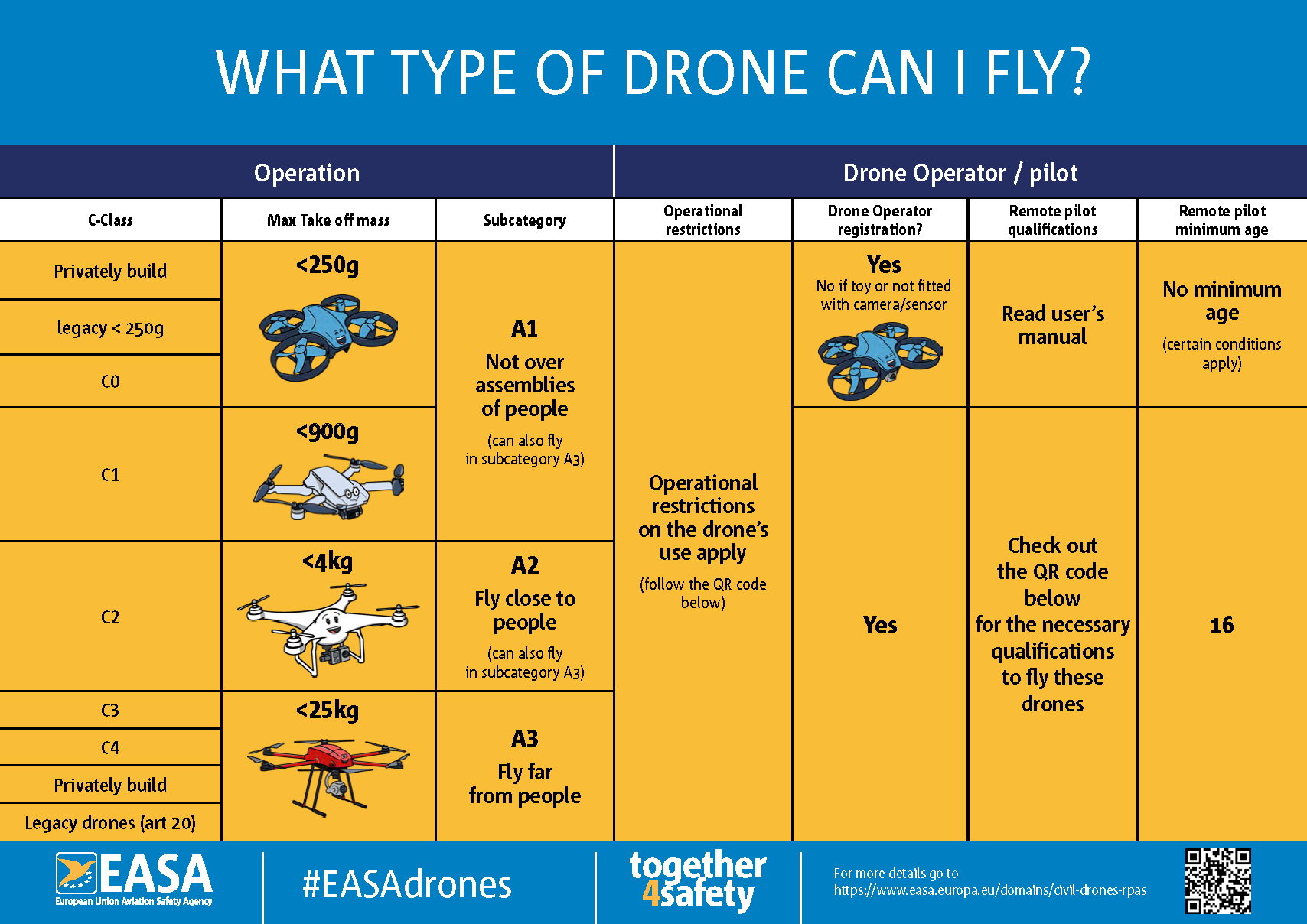
The EASA framework assigns drones a class designation from C0 to C6 based on their technical specifications, safety features, and performance limits. Defined in Delegated Regulation (EU) 2019/945, a drone must carry a physical CE class label to be formally assigned to a class. Weight is a primary factor in determining class, but a drone must also meet specific technical requirements — including Remote ID capability for C1 and above.
| Class | Weight Range | Key Technical Requirements | Subcategory |
|---|---|---|---|
| C0 | Under 250g | No CE marking required | A1 — can fly over people |
| C1 | 250g–900g | CE marking, Remote ID | A1 — avoid flight over people |
| C2 | 900g–4kg | CE marking, Remote ID, certified low-speed mode | A2 — requires A2 CofC |
| C3 | 4kg–25kg | CE marking, Remote ID | A3 — far from people |
| C4 | Up to 25kg | CE marking | A3 — specific conditions |
What Is Remote ID?
Remote ID is a technical requirement for CE-marked C1 class drones and above that mandates the aircraft broadcast its identity and position in real time. Think of it as a digital registration plate that any receiver — an authority, another pilot, or a UTM system — can read while your drone is in the air.
Specifically, a Remote ID compliant drone broadcasts: its serial number, its real-time GPS position and altitude, the remote pilot’s position or take-off point, and its speed and heading. This data is transmitted continuously during flight. In Germany, the DFS and LBA are building UTM infrastructure that reads Remote ID signals as part of the U-Space framework.
For most pilots, Remote ID is a background compliance feature built into newer CE-marked drones — you don’t actively manage it during a flight. The practical implications: if you are flying a drone that requires Remote ID and your aircraft doesn’t have it (or it is disabled), you are not in compliance with the CE class requirements and cannot claim the benefits of that class designation.
Legacy Drones Without CE Class Markings
This section is critical for anyone flying a DJI Mavic 2, Phantom 4, original Inspire, or any drone purchased before the C-class system was in effect — drones without a CE class marking are “legacy” UAS and operate under transitional rules that carry expiry dates.
Under the EU transition regime, legacy drones (no CE class label) are operated as follows:
- Under 250g: Treated as C0 — EU online theory only, no registration required in most EU states
- 250g–500g: Can fly in A1 subcategory after completing the EU online theory test
- 250g–2kg: Can fly in A2 subcategory if the pilot holds the A2 CofC — this is the legacy A2 provision (distinct from the C2 class rule of 900g–4kg)
- 2kg–25kg: A3 subcategory only — 150m from populated areas
This is why two different weight ranges appear in different drone law guides for the A2 subcategory. Both “900g–4kg” and “250g–2kg” are correct — they refer to different drone types. The 900g–4kg rule applies to CE-marked C2 class drones. The 250g–2kg rule is the legacy transitional provision for drones without CE markings.
⚠️ Warning — Transition Period Expiry: The EU transition period for legacy drones was introduced in January 2021 and has been extended multiple times since. Transition provisions do have expiry dates and are not guaranteed to remain in effect indefinitely. If you are relying on legacy transitional rules to operate, check the current transition period status directly at easa.europa.eu/drones before flying — the rules you read about elsewhere, including in older versions of this guide, may no longer apply.
💡 Pro Tip: To check whether your specific drone carries a CE class marking, inspect the physical body of the aircraft for a label showing “C0,” “C1,” etc., and check the manufacturer’s documentation. DJI drones sold in the EU from approximately late 2023 onwards began carrying CE class markings on newer models. Earlier models generally do not. The DJI Mini 4 Pro was among the first Mini-series drones to receive a CE C0 marking. Check your specific model — don’t assume based on purchase date alone.
The Three EASA Categories: Open, Specific, Certified
The category you fly in determines everything else about your legal obligations — and correctly identifying your category is the most important step in understanding drone law.
Open Category: Where Most Pilots Operate
The Open Category is the standard framework for recreational flyers, hobbyists, content creators, and most commercial operators. It requires no prior authorisation — you can fly within its rules without applying for anything, provided you meet the conditions.
Subcategory A1 — Over people (with limits): For C0 class drones (under 250g) and C1 class drones (250g–900g), plus legacy drones under 500g. C0 drones can fly over uninvolved persons but not over assemblies of people. An “assembly of people” is defined in the EASA framework as a gathering where individuals cannot freely move away — a street crowd, a festival, a sports event. C1 drones should avoid intentional overflight of uninvolved persons where reasonably practicable. EU online theory test required for C1.
Subcategory A2 — Close to people: For CE-marked C2 class drones (900g–4kg with certified low-speed mode), or legacy drones 250g–2kg without CE marking. A2 CofC required. Minimum horizontal distance from uninvolved persons: 30 metres. For C2 class drones equipped with a manufacturer-certified low-speed mode (maximum 3 m/s horizontal speed), this minimum distance can be reduced to 5 metres — per UAS.OPEN.020(3)(b) of Commission Implementing Regulation (EU) 2019/947. Note: this reduction applies only to drones with a certifiably compliant low-speed mode; not all C2-weight-range drones have this feature.
Subcategory A3 — Far from people: For all drones up to 25kg, flown at least 150 metres from residential, commercial, industrial, or recreational areas. The term “recreational area” includes parks, beaches, and similar spaces where members of the public routinely gather. EU online theory test only. The “open countryside, nobody in range” category.
⚠️ Warning: The maximum altitude across all Open Category subcategories is 120 metres above ground level (AGL) — not above sea level. There are no exceptions within Open Category. Exceeding 120m AGL requires Specific Category authorisation from the LBA.
Specific Category
Covers operations exceeding Open Category’s risk profile: BVLOS flights, intentional flight over crowds in controlled conditions, platforms above 25kg, or complex urban operations. Requires a Specific Operations Risk Assessment (SORA) or Pre-Defined Risk Assessment (PDRA) approved by the LBA in Germany. Most photographers and videographers will never need this.
Certified Category
Applies to very large drones used for passenger transport or hazardous goods delivery — effectively manned aviation rules. Not relevant to the overwhelming majority of pilots reading this.
German Drone Law: LBA, Registration, Insurance & Privacy
Germany has some of the most strictly enforced drone regulations in the EU — and the Luftfahrt-Bundesamt (LBA) is the authority responsible for registration, licensing, and operational oversight.
I’ve been operating commercially in Germany for years. The single most important professional habit I’ve built is having documentation fully in order before arriving at a shoot location — not assembling it in the car park.
Registration: Who Needs It and How
Any drone with a maximum take-off mass (MTOM) above 250g must be registered with the LBA. You receive an operator e-ID that must be affixed to each drone as a permanent, legible, weather-resistant label.
Note: Verify the current registration fee directly at lba.de before starting the process — fees are subject to change and any figure published in an article can become outdated.
For drones below 250g, registration is not currently required. However, privacy law obligations under the DSGVO apply regardless of weight — see below.
Registration steps:
- Go to lba.de → Drohnen → Registrierung
- Create an account with your full name, address, and date of birth
- Complete the free online EU Drone Pilot Competency test (40 questions, pass mark 75%)
- Pay the registration fee (verify current amount at lba.de)
- Receive your operator e-ID
- Affix the e-ID label permanently to every drone above 250g you operate
Drone Insurance Requirements
Third-party liability insurance is legally mandatory for all drone operations in Germany under the Luftverkehrsgesetz (LuftVG) — no exceptions for small drones, recreational use, or short flights.
Note: The specific statutory minimum coverage level is defined in the LuftVG and associated regulations. Verify the current requirement directly against the LuftVG text or at lba.de before purchasing a policy — the precise minimum figure can change with legislative updates and should not be taken from third-party sources alone.
Specialist drone insurance policies start at approximately €50–€90/year for recreational pilots and €120–€250/year for commercial operators, though your actual quote depends on drone type, operating geography, and use case. When reviewing any policy, confirm it explicitly covers: (a) the drone’s take-off weight, (b) commercial use if applicable, and (c) your operating countries. Policies marketed as “Haftpflichtversicherung für Drohnen gemäß LuftVG” are specifically structured for this obligation.
Your existing Privathaftpflichtversicherung may cover recreational flights with small drones — but verify this explicitly in writing with your insurer. Many standard household policies exclude drones above 250g and all commercial use. A dedicated drone policy removes all ambiguity and is the cleanest solution for any pilot flying regularly.
⚠️ Warning: Flying without insurance in Germany is a criminal offence under the LuftVG — not an administrative penalty. Uninsured commercial operators additionally face personal civil liability for any damage or injury caused. Do not fly without confirmed, current insurance in place.
Privacy Law: DSGVO Obligations for Drone Pilots
Drone cameras create personal data the moment they capture identifiable individuals — and the DSGVO (Germany’s implementation of the EU GDPR) applies to this data regardless of the drone’s weight or registration status.
For recreational pilots, the DSGVO’s “household exemption” (Haushaltsprivileg) may apply if you are filming purely for personal, non-public use. The moment you publish footage online, share it commercially, or film at an event, this exemption no longer applies.
For commercial operators, the key obligations are: you must have a lawful basis for processing personal data (typically legitimate interest or consent), you must minimise capture of identifiable persons where possible, footage containing identifiable faces should be anonymised or deleted if not required for the commissioned deliverable, and if asked by an individual in your footage to delete their data, you are generally obliged to comply under DSGVO Article 17. For commercial shoots in public spaces, having a visible notice at the shoot location informing the public that aerial filming is in progress is both a professional practice and a good-faith DSGVO measure. Consult a DSGVO-specialist lawyer if your commercial operations routinely involve filming identifiable individuals in public spaces.
How to Get Your EU Drone Licence: A2 CofC Step by Step
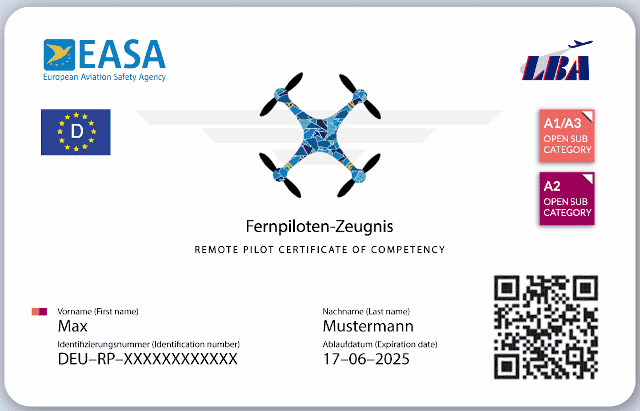
The A2 Certificate of Competency is the single most important licence for any pilot flying a CE-marked C2 class drone, or a legacy drone between 250g and 2kg — and it is more achievable than most people assume.
The A2 CofC unlocks subcategory A2 operations: flying at a minimum horizontal distance of 30 metres from uninvolved people (reducible to 5m in certified low-speed mode for qualifying C2 drones). For real estate aerial photography, construction site documentation, hotel campaigns, and event coverage — this licence is what makes professional work legally viable in and near populated environments.
Step 1: Complete the EU Open Category Online Theory Training
Before sitting the A2 exam, you must first complete the EU Open Category online training and pass the EU Drone Pilot Competency test. This is a prerequisite for the A2 pathway — it is the same qualification required for drone registration with the LBA.
Step 2: Study for the A2 Theory Exam
The A2 CofC theory exam covers material not included in the basic competency test:
- Meteorology: weather systems, wind layers, visibility, cloud types, convective activity, and their practical impact on drone flight performance and decision-making
- Flight physics: aerodynamic principles, how drones respond to payload, temperature, altitude, and battery state
- Technical and operational risk mitigation: failure modes, emergency procedures, systematic pre-flight planning
- Human performance: situational awareness, decision-making under stress, the limits of the human visual system when tracking a drone at distance
- Advanced airspace knowledge: controlled airspace classes, altitude reporting, NOTAM interpretation, coordination with manned aviation
The EASA Drone Pilot eLearning Course (free at easa.europa.eu/en/domains/drones) covers all required theory topics. Third-party structured courses are available in both English and German from providers including DronePilot Academy and Drohnen Akademie. Budget 8–15 hours of dedicated study for the theory component.
Step 3: Pass the A2 Theory Exam at an Approved Centre
The A2 CofC theory exam consists of 40 multiple-choice questions. The pass mark is 75% — 30 correct answers required. The exam is conducted at an LBA-approved examination centre; the current list of approved centres is at lba.de. Exam fees vary by centre — verify the current fee range before booking.
Step 4: Complete Self-Supervised Practical Training
The A2 CofC does not require a practical flight test administered by an external examiner. Pilots must complete self-supervised practical training in a subcategory A3 environment (away from people and populated areas), covering normal flight operations and abnormal situations: GPS signal loss, strong crosswind conditions, and controlled emergency landing procedures. You then self-declare completion through your LBA account.
💡 Pro Tip: Don’t treat the practical phase as a formality. I ran three dedicated sessions in an open field outside Ulm specifically practising manual GPS-off landings and controlled crosswind approaches before self-declaring. On a commercial real estate shoot in Stuttgart with gusting crosswinds, that practice was the difference between a clean job and an incident. The exam tests your knowledge. The practical phase tests whether you can actually control the aircraft when things go wrong.
No-Fly Zones: How to Check Airspace Before Every Flight
No-fly zones are legally binding airspace restrictions carrying significant penalties for violation — and in Germany, they are enforced with genuine rigour.
The EASA framework introduces the concept of U-Space: a structured approach to managing drone operations within defined airspace volumes. Within U-Space, certain zones are designated as restricted (prior authorisation required), others are prohibited (no flight permitted under any circumstances), and the remainder is uncontrolled airspace where Open Category operations are permitted by default subject to subcategory rules.
Types of Restricted Zones in Germany
Airport control zones: Every commercial and regional airport in Germany has a protected airspace zone where drone flight is prohibited without explicit authorisation from air traffic control. The shape and size varies by airport — it is never a simple uniform circle. Always check the exact geometry in DronIQ. Stuttgart, Munich, Frankfurt, Memmingen, and Friedrichshafen all have zones that directly affect pilots across Baden-Württemberg and Bavaria.
Nature reserves and national parks: Germany’s network of protected areas — Naturschutzgebiete, Nationalparks, and Biosphärenreservate — prohibits drone flight without special permit, particularly during breeding and nesting seasons (broadly March–August, though exact dates and conditions vary by specific designation and federal state). The Schwarzwald, the Schwäbische Alb Biosphere Reserve, and Nationalpark Berchtesgaden all carry restrictions. The specific legal category of each protected area determines the exact rules — a Naturschutzgebiet may have different conditions than a Nationalpark in the same region. Verify the Schutzgebiet designation for each location individually before flying.
Military and government facilities: Hard prohibited zones around Bundeswehr installations, federal government infrastructure, and border control facilities. No applications or workarounds exist for these.
Urban areas and city centres: Flying over densely populated urban areas conflicts with subcategory A3 requirements (150m from residential, commercial, recreational areas) and may require explicit Ordnungsamt approval for Open Category operations. Properly permitted urban shoots are legally possible — but they require advance planning, not spontaneous decision-making on location.
Temporary Restricted Areas (TRAs): Issued for events, state visits, emergency operations, and military exercises. Time-limited, but legally binding during their active window. Integrated in real-time into DronIQ and AirMap via NOTAM feeds. The most common source of surprise for pilots who check airspace once and then re-use a location weeks later without re-checking.
The 120-Metre AGL Rule
The maximum permitted altitude in the Open Category is 120 metres above ground level (AGL) — not above sea level. “Above ground level” means above the terrain directly beneath the drone at the moment of flight. Flying above a ridgeline at 2,800m elevation with a 120m Open Category ceiling puts your drone at approximately 2,920m above sea level — within the rule, but altitude that matters for battery performance, temperature effects, and aircraft stability.
⚠️ Warning: Some DJI firmware configurations enforce altitude limits relative to sea level rather than local terrain. Before any mountain flight, confirm in the DJI Fly app settings that your altitude mode references local ground level, not a fixed sea-level baseline. This is particularly critical on Italian and Austrian Alpine shoots where take-off elevation changes dramatically within short distances.
Apps & Tools for Checking Drone Airspace
The right apps make airspace checking fast, accurate, and routine. Using them before every single flight is one of the simplest habits separating experienced pilots from those who eventually get caught out.
DJI Fly — First Check, Not Final Check
The DJI Fly app overlays restricted zones on the map interface and generates pre-takeoff warnings near restricted areas. It hard-locks takeoff in some prohibited zones. It is a useful geographic first orientation — it is not a sufficient compliance check. The DJI geofencing database is maintained by DJI, not by EASA or national authorities, and can lag behind official airspace changes by days or weeks. Use DJI Fly to see the general picture; use an official app to make your compliance decision.
DronIQ — The German Standard
DronIQ is endorsed by the German LBA and the DFS (Deutsche Flugsicherung — Germany’s air navigation service provider). It pulls data directly from official German airspace databases and integrates with the DFS UTM system. For flying anywhere in Germany, DronIQ is the most authoritative freely available source. It shows restricted zones, Naturschutzgebiet boundaries, active TRAs, and in many restricted zones allows you to submit a digital flight authorisation request directly through the app. Free to download and use.
AirMap — Cross-Border Operations
AirMap aggregates official airspace data per country and provides a consistent interface for airspace checking and flight planning across borders. For pilots operating across Germany, Italy, Austria, and Switzerland in the same calendar month, AirMap’s unified interface is significantly more efficient than switching between four national apps. Its datasets for Italy, Austria, and Switzerland are maintained to a professional standard and cover the Alpine region well.
NOTAM — Always Check Before Events or High-Activity Areas
NOTAMs (Notices to Airmen) are official aviation notices covering temporary airspace changes. In Germany, current NOTAMs are available at dfs.de and integrated into both DronIQ and AirMap. Run a NOTAM check before any flight near an event venue, sports stadium, or area with unusual air activity — TFRs in these areas have caught experienced pilots off-guard.
💡 Pro Tip: My pre-shoot airspace routine runs three layers in sequence: (1) DronIQ for the current German airspace status at the exact GPS coordinates, (2) the relevant municipality or venue website for any local event calendar restrictions, (3) a physical walk of the site on arrival to visually confirm no temporary signage posted since the digital check. This three-layer routine has flagged active restrictions twice in the past 18 months — both times, a TRA had been issued after the shoot was already booked with the client.
What Documents to Carry When Flying
On any flight — recreational or commercial — having the right documentation immediately accessible is the difference between a two-minute conversation with an authority and a three-hour problem.
Minimum Documentation — All Pilots
- Proof of operator registration (e-ID): The physical label affixed to the drone satisfies this on-aircraft. Additionally carry a screenshot or printout of your LBA registration confirmation on your phone
- Proof of insurance: Your insurance certificate showing name, policy number, coverage level, and validity period. A photo in your phone’s camera roll is sufficient — the key is that it is immediately accessible
- Pilot competency certificate: Your EU online theory completion confirmation, or your A2 CofC certificate, depending on which subcategory you are operating in. Carry whichever applies to the specific drone you are flying that day
Additional Documentation — Commercial Pilots
- Written project brief or shoot plan: A one-page summary of the project, location, planned flight area, and duration. Answers every authority’s first question immediately and positions you as a professional
- Airspace check screenshot: A dated screenshot from DronIQ or AirMap showing the flight location as clear, taken on the day of the shoot — not from a previous visit
- Site access confirmation: If operating from private property or a client-controlled site, carry written confirmation (email is sufficient) that you have been granted permission to operate
💡 Pro Tip: I keep all of this in a single folder on my phone labelled “Drone Docs.” Before every job, I update the airspace screenshot and confirm the insurance validity date. The whole process takes four minutes. On a commercial shoot in Ulm last autumn, I was approached by a Polizei patrol within ten minutes of setup and asked to show documentation. Having everything in one folder, immediately accessible, turned what could have been a complication into a two-minute exchange and a conversation about the project. Four minutes of preparation; two minutes on site. That ratio is worth it every time.
Country-Specific Rules: Italy, Austria & Switzerland
Flying across EU borders is significantly simpler post-2021 — your EASA competency and German registration are broadly recognised — but each country adds its own layer on top of the harmonised baseline.
As someone who regularly shoots in the Dolomites, Lake Como, and the Gesäuse in Austria, I navigate these additions personally and repeatedly. Always verify the current position with the relevant national authority before an international trip.
Italy: Flying in the Dolomites and Lake Como
Italian Drone Law — ENAC Rules Position as understood: April 2026 — verify current rules at enac.gov.it and d-flight.it before flying
Italy’s national aviation authority, ENAC (Ente Nazionale per l’Aviazione Civile), manages drone regulation on top of the EASA framework. For pilots visiting from Germany:
National parks: Italy has an extensive network of national parks (the count has grown over the years — verify the current list at enac.gov.it or parks.it). All carry strict drone prohibitions without a rare special ENAC authorisation. The Dolomiti Bellunesi National Park and Stelvio National Park are complete no-fly zones for standard operations. These restrictions are most strictly enforced during summer season.
Urban historic centres: Flying over UNESCO World Heritage Sites and most Italian town centres requires specific ENAC authorisation. For practical purposes, Venice, Florence, Rome, and Verona are not available for spontaneous commercial or recreational use. Plan and apply in advance if your project requires these locations.
Lake Como: The lake sits within airspace affected by traffic patterns from Lugano and Milan Malpensa. Flight planning around the lakefront is possible but requires careful per-session checking via the D-Flight app. When I shoot at Lake Como, I cross-reference AirMap to identify potentially clear zones and D-Flight to confirm the current status for that specific date — never relying on a previous visit’s check.
D-Flight app: Download before entering Italy. Italy’s official drone flight authorisation platform and the tool for applying for approvals in restricted areas.
For Dolomites shoots: Mountain passes and valleys above the national park core boundaries offer spectacular flying with significantly less regulatory friction. Passo Giau, sections of the Cinque Torri area outside the Dolomiti Bellunesi core boundary, and the Falzarego Pass all present viable legal operational options — provided D-Flight and AirMap are checked per location and per date.
Austria: Gesäuse and Alpine Flying
Austrian Drone Law — Austro Control Position as understood: April 2026 — verify current rules at dronespace.at and austrocontrol.at before flying
Austria’s drone framework is managed by Austro Control and closely mirrors EASA’s Open Category structure. Key specifics for pilots crossing from Germany:
Protected areas: The Gesäuse National Park, Hohe Tauern, and the Nockberge Biosphere Reserve all carry drone restrictions. Some zones permit restricted A3 operations in non-core areas — but the specific Schutzgebiet legal designation determines what is permitted, and these vary significantly. Check dronespace.at for each location individually; do not generalise from one Austrian protected area to another.
Registration recognition: Germany’s LBA registration and A2 CofC are recognised in Austria as EU-harmonised credentials. No separate Austrian registration or licence required for Open Category operations.
Insurance: Austrian law requires third-party liability insurance at the EU standard. Your German policy should be valid for EU-wide operations if explicitly stated in the policy terms — confirm this in writing with your insurer before your first Austrian shoot.
Dronespace.at: Austria’s official drone operations platform. Download before entering Austria.
Switzerland: BAZL Rules — Non-EU
Swiss Drone Law — BAZL Position as understood: April 2026 — verify current rules at bazl.admin.ch before flying
Switzerland is not an EU member state. EASA regulations do not automatically apply. Your German LBA registration is not sufficient for legal drone operation in Switzerland.
Separate BAZL registration required: Drones above 250g must be registered separately with the BAZL (Bundesamt für Zivilluftfahrt) at bazl.admin.ch. This is a distinct process from your LBA registration.
Competency recognition: Switzerland has bilateral agreements broadly recognising EU drone pilot credentials including the A2 CofC — but the specific terms can and do change. Verify current recognition status at bazl.admin.ch before your trip, not on arrival.
Nature protections: The Swiss Alpine protection framework is strict and multi-layered. Jungfrau-Aletsch, the Engadin Valley, and most designated mountain reserve zones carry significant restrictions. The Swisstopo app and AirMap’s Switzerland layer both display Swiss restricted zones.
Insurance: Verify your EU policy explicitly covers Switzerland — coverage boundaries do not automatically extend across the Swiss border.
| Country | EASA Aligned | Key App | National Parks | German Reg. Valid | German Insurance Valid |
|---|---|---|---|---|---|
| Germany | ✓ Yes | DronIQ | Prohibited | Home country | Home country |
| Italy | ✓ Yes | D-Flight | Prohibited | ✓ Yes | ✓ If EU-wide on policy |
| Austria | ✓ Yes | Dronespace.at | Case by case | ✓ Yes | ✓ If EU-wide on policy |
| Switzerland | ✗ Bilateral only | AirMap CH / Swisstopo | Prohibited | ✗ BAZL reg. needed | Verify separately |
| France | ✓ Yes | Géoportail + Alpha Tango | Prohibited | ✓ Yes | ✓ If EU-wide on policy |
Commercial Drone Operations in the EU
The most persistent misconception in EU drone law is that commercial operations automatically require Specific Category authorisation — they do not. Most commercial drone work falls squarely within the Open Category, governed by exactly the same rules as recreational flying, with two practical differences: insurance must explicitly cover commercial use, and client sites often impose their own documentation requirements.
I run commercial aerial production projects across Germany and Europe under the Open Category framework. Real estate aerial photography in Stuttgart, hotel campaigns across Lake Como — all conducted under Open Category rules, all fully legal, without Specific Category SORA paperwork.
What "Commercial" Actually Means Under EASA
EASA’s category framework is divided by operational risk, not financial intent. A hobbyist and a commercial operator flying the same drone on the same route face identical regulatory requirements. The category framework applies equally to both.
What changes in a commercial context:
- Insurance must explicitly cover commercial activities. Most recreational policies exclude commercial use — verify in writing before your first paid job, not after
- Contractual liability exposure. Errors in a commercial engagement carry financial and legal consequences that don’t exist in recreational flying
- Client site requirements. Construction sites, hospitality groups, and corporate clients routinely require proof of insurance, licence documentation, and a written safety plan before granting access. This is contractual rather than regulatory — but failing to have documentation ready loses work
When Specific Category Is Actually Required
Specific Category operations in Germany require a SORA or PDRA approved by the LBA. Practical triggers:
- BVLOS (beyond visual line of sight) flight
- Intentional flight over controlled crowds at large events
- Operating platforms above 25kg MTOM
- Certain complex urban scenarios with a formally assessed risk profile exceeding Open Category thresholds
Standard commercial production work — real estate photography, hotel campaigns, outdoor event coverage at standard venues — does not require Specific Category authorisation in the vast majority of cases.
Need a professional drone operator for your project — fully licenced, insured, and experienced across Germany and Europe?
Aero Timelapse Studio is based in Ulm, Germany. We hold A2 CofC certification and carry commercial liability insurance valid across Germany, Italy, Austria, and Switzerland. We deliver real estate aerial photography, hotel and tourism campaigns, and event coverage — including all airspace checks, permits, insurance documentation, and client-facing safety planning as part of every project.
Request a free project quote → aerotimelapse.com/contact/
Services: Drone Videography · Timelapse Production · Drohnenfotograf Ulm
Go Deeper: Related Guides on Aero Timelapse
Flying legally is one part of flying well. These guides cover drone technique, gear decisions, commercial workflows, and the tools that make every shoot more efficient.
Drone Technique & Safety
- 🚁 The Complete Drone Videography Guide (2026) — Camera settings, shot types, editing workflows, and cinematic technique from beginner to professional level
- ✅ Drone Pre-Flight Checklist for Beginners — Run this before every flight: batteries, airspace, insurance, and physical safety checks in one sequential list
Buying a Drone
- 📋 Drone Buying Checklist (2026) — Everything to verify before purchasing, including how weight class and CE marking affect your registration and licence requirements
Services
- 📍 Drohnenfotograf Ulm — Local Hub — Professional drone production across Ulm and Baden-Württemberg
- 🎬 Drone Videography Service — Commercial aerial video production, fully licenced and insured for EU operations
Tools
- 🔧 Free Drone Hyperlapse Calculator — Calculate precise step distances and intervals for drone and ground hyperlapses
- 🔧 Timelapse Interval Calculator — Calculate shooting interval for any subject, clip length, and frame rate
Frequently Asked Questions
Do I need a licence to fly a drone in Germany?
It depends on your drone’s weight, class, and intended subcategory. For drones under 250g, you need to complete the LBA’s free online competency test — no physical exam required. For CE-marked C2 class drones (900g–4kg) or legacy drones between 250g and 2kg without CE marking, you need the A2 Certificate of Competency to fly in subcategory A2. For drones up to 25kg flown in subcategory A3 (150m or more from populated areas), only the online theory test is required. All drones above 250g must be registered with the LBA and carry mandatory third-party liability insurance.
What is the EASA C-class system and why does it matter?
The EASA C-class system assigns drones a class designation from C0 to C4 based on their technical specifications and safety features. The class determines which Open Category subcategory the drone can operate in — not just its weight. C0 (under 250g) flies in A1, C1 (250g–900g) flies in A1 with restrictions, C2 (900g–4kg, with certified low-speed mode) flies in A2 and requires the A2 CofC. Drones without a CE class marking — including most DJI drones sold before late 2023 — operate under transitional “legacy” rules instead. Knowing your drone’s class status is more important than knowing its weight in grams.
What is the A2 Certificate of Competency and who needs it?
The A2 CofC is the EU drone pilot licence required to operate CE-marked C2 class drones (900g–4kg) in the A2 subcategory — as close as 30m to uninvolved people, reducible to 5m in certified low-speed mode. It also applies to legacy drones between 250g and 2kg without CE class markings. The A2 CofC requires passing a theory exam (40 questions, 75% pass mark) at an LBA-approved centre, plus self-supervised practical training with a self-declaration of completion. It is the most practically important qualification for any pilot operating a DJI Air 3, Mavic 3, or equivalent platform near people or in populated environments.
Is drone insurance mandatory in Germany?
Yes. Third-party liability insurance is legally mandatory for all drone operations in Germany under the Luftverkehrsgesetz (LuftVG). Flying without it is a criminal offence, not merely an administrative penalty. Verify the current statutory minimum coverage level directly against the LuftVG text or at lba.de — specific figures are subject to legislative update and should not be relied upon from third-party sources alone. Many standard household liability policies (Privathaftpflichtversicherung) exclude drones above 250g and all commercial use — confirm your coverage position in writing with your insurer.
Does my German LBA registration and A2 CofC work in other EU countries?
Yes, for EU member states. The EASA framework is harmonised across the EU, so your LBA registration and A2 CofC are recognised throughout the union. However, each country adds restrictions on top of the baseline — national park prohibitions, city centre rules, temporary flight restrictions, and mandatory use of national airspace apps (DronIQ in Germany, D-Flight in Italy, Dronespace.at in Austria). Switzerland is not an EU member and requires a separate BAZL registration. Always download the relevant national app and verify local additions before flying abroad.
What apps should I use to check drone no-fly zones?
Use at least two sources before every flight. In Germany, DronIQ is the official LBA and DFS-endorsed app — use it as your primary airspace check. The DJI Fly app provides a useful visual overlay but is updated by DJI rather than official authorities — treat it as secondary confirmation only. In Italy, use D-Flight. In Austria, use Dronespace.at. For cross-border operations across the Alps, AirMap covers multiple countries with consistent data quality. Always supplement with a NOTAM check at dfs.de before any flight near event venues or high-activity areas.
What happens if I fly a drone illegally in Germany?
Penalties are enforced by the LBA, local Ordnungsamt, and in serious cases the Staatsanwaltschaft (public prosecutor). Fines range from several hundred euros for minor infringements to over €50,000 for serious airspace violations. Dangerous interference with air traffic — such as flying near an active airport without authorisation — can result in criminal prosecution under the German Criminal Code. §315 StGB (Gefährliche Eingriffe in den Bahn-, Schiffs- und Luftverkehr) covers dangerous interference with rail, ship, and air traffic and may apply in serious incidents; the exact provision depends on the circumstances. Consult a qualified German aviation lawyer for guidance on any serious incident or prosecution. Equipment can be confiscated pending investigation. Commercial operators additionally face civil liability for any damage or injury caused.
Do I need a special licence for commercial drone photography in Germany?
No separate commercial licence exists under EU or German law — commercial and recreational operations are governed by the same EASA category framework based on operational risk, not intent. Most commercial aerial photography (real estate, tourism, construction documentation, event coverage) falls within the Open Category. The key differences for commercial operators are: (1) insurance must explicitly cover commercial use, (2) client sites often require documentation before granting access, and (3) contractual liability exposure means errors carry financial consequences beyond a recreational incident. Specific Category authorisation is only required for BVLOS flight, heavy platforms, or complex operations exceeding Open Category risk thresholds.
Can I fly my drone over a sports event or festival in Germany?
Not without specific authorisation. Open Category rules prohibit intentional flight over assemblies of people where the crowd density makes a drone incident potentially catastrophic. For any flight over a concert, football match, festival, or public gathering, you would need either Specific Category SORA approval from the LBA or explicit local authority (Ordnungsamt) permission, plus coordination with the relevant air traffic authority where airspace is affected. Submit applications at least 4–6 weeks before the event date. Violations at events carry some of the highest penalties in the German regulatory framework.
What is the difference between a C1 and C2 class drone?
C1 class drones (250g–900g, CE-marked) operate in subcategory A1 — the pilot should avoid intentional flight over uninvolved persons where reasonably practicable, but no minimum distance is prescribed. C2 class drones (900g–4kg, CE-marked) require the pilot to hold the A2 CofC and must maintain a minimum horizontal distance of 30m from uninvolved persons — reducible to 5m in certified low-speed mode. C2 drones must also have a factory-certified low-speed mode capped at 3 m/s. The practical boundary sits around the 900g mark; verify the specific CE marking on your exact drone model before assuming which subcategory applies, as class marking is a property of the specific approved model, not just its weight.
The Most Important Thing to Do Right Now
The regulatory framework described in this guide is substantial — but the daily compliance behaviour it requires is genuinely simple: check airspace, carry your documents, confirm your insurance covers this specific use, know your subcategory, fly within it.
Every incident, every fine, and every confiscated drone I’ve heard about from pilots across this community had one thing in common: a step in that sequence was skipped. Not always out of ignorance — sometimes out of misplaced confidence that “this location is always fine.” Regulations change. Temporary restrictions are issued. A location you flew clean last month may carry a TRA today.
The single most actionable thing you can do right now is download DronIQ, run your next planned location through it, and confirm your insurance certificate is current and accessible on your phone. That takes eight minutes. It makes every flight after it cleaner and more professional.
If you’re still deciding which drone to buy, the Drone Buying Checklist covers how weight class and CE marking should factor into your decision. When you’re ready to fly, the Drone Pre-Flight Checklist runs you through the complete on-the-day sequence.
And if your project needs a fully licenced, insured, and experienced aerial team — for a real estate campaign in Stuttgart, a tourism film across Lake Como, or an event production in Baden-Württemberg — Aero Timelapse Studio is ready to talk.

Dipon is a drone and timelapse cinematographer based in Ulm, Germany, with over 15 years of experience turning real spaces and projects into cinematic visuals. With a background in digital marketing, every shot is planned with a clear purpose — where it will appear, who will see it, and what it should help them decide.
You May Also Like
How to Shoot a Little Planet Photo With a Drone
Best Drones for Beginners (2026): Safe, Easy Picks + Buying Guide
Why Sensor Size Matters When You’re Buying a Drone
How Weather Affects Timelapse & Drone Shoots
DJI Lito X1 vs Mini 5 Pro: Which Ultralight Drone Belongs in Your Camera Bag?
DJI Mavic 4 Pro vs DJI Air 3S
DJI Air 3S Review: The Sweet-Spot Drone for Creators and Professionals
DJI Mavic 4 Pro Review: Is It Worth It for Professional Work? (2026)

Best Prime Week Drone Deals for Creators and Beginners

DJI Lito X1 Review: The Ultimate Pocket-Sized B-Cam for Creators?

Best Time to Fly a Drone for Photography
DJI Flip vs DJI Neo 2: Which Pocket Drone is Better for Travel Creators?
Need help capturing aerials for your next project but not ready to invest in the gear yet? Check out our Drone Videography to see how Aero Timelapse Studio can help elevate your production.