Why Sensor Size Matters When You're Buying a Drone
Dipon | September 2026
Table of Contents
Affiliate Disclosure
This guide contains affiliate links. Purchases made through these links support Aero Timelapse Studio at no additional cost to you. I only recommend products I personally use or carefully research. As an Amazon Associate I earn from qualifying purchases.
You’re comparing three drones in eight open tabs, and every spec sheet lists the sensor as a fraction — 1/1.3-inch, 1-inch, 4/3-inch — with zero indication of what that actually buys you in the air. Meanwhile the megapixel count is huge and bold, because that’s the number marketing wants you looking at. It’s the wrong number, and understanding why sensor size matters is the first thing to sort out before you look at a single model name.
Sensor size is the single spec that determines how much light your drone’s camera physically captures, and that decides your noise levels at dusk, your dynamic range in a contrasty scene, and how much room you have to grade footage without it falling apart. After shooting real estate, hotel, and event work across Southern Germany and the Alps on everything from a 1/1.3-inch Mini to a 4/3-inch Mavic, I can tell you the sensor is where most buyer’s remorse actually starts. By the end of this guide you’ll know exactly what each sensor size buys you and which one matches your actual shooting plans — then you can put your shortlist to the test, side by side and drawn to true scale, with our free Drone Sensor Comparator.
Key Takeaways
- Sensor size is measured in physical area (mm²), not the confusing fraction printed on spec sheets — a 1-inch sensor is 116.2mm², not one inch across.
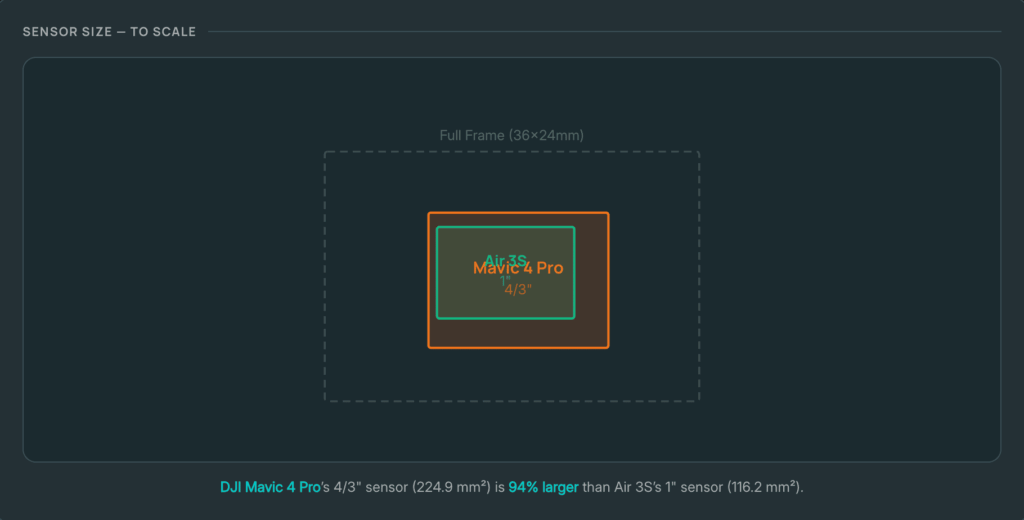
- Moving from a 1/1.3-inch sensor to a 1-inch sensor is a 68% increase in light-gathering area; 1-inch to 4/3-inch is another 94% jump.
- Bigger isn’t automatically better — a larger sensor usually means a heavier drone, a higher price, and in the EU, a different weight-class registration bracket.
- The DJI Mini 5 Pro is currently the only sub-250g drone with a 1-inch sensor, which changes the trade-off calculation for hobbyists.
- Your use case decides the right sensor more than any spec sheet ranking does — timelapse and low light reward sensor area, stock footage rewards resolution and cropping room.
- Use the Drone Sensor Comparator to see your shortlist drawn to true scale rather than guessing from a fraction.
What Is Drone Sensor Size, Actually?
Drone sensor size means the physical surface area of the image sensor inside the camera, measured in millimetres, not the inch-based fraction printed on the spec sheet. “1-inch” is a legacy label from 1950s video camera tubes — it has nothing to do with the sensor’s actual 13.2 × 8.8mm dimensions. The number that predicts image quality is the sensor’s area: a 1-inch sensor covers 116.2 square millimetres, physically capturing far more light per exposure than a smaller chip at the same settings.
💡 Pro Tip: Ignore the inch label entirely and look for the millimetre dimensions or the square-millimetre area instead. It’s the only number on a drone spec sheet that tells you the truth about low-light and dynamic-range performance.
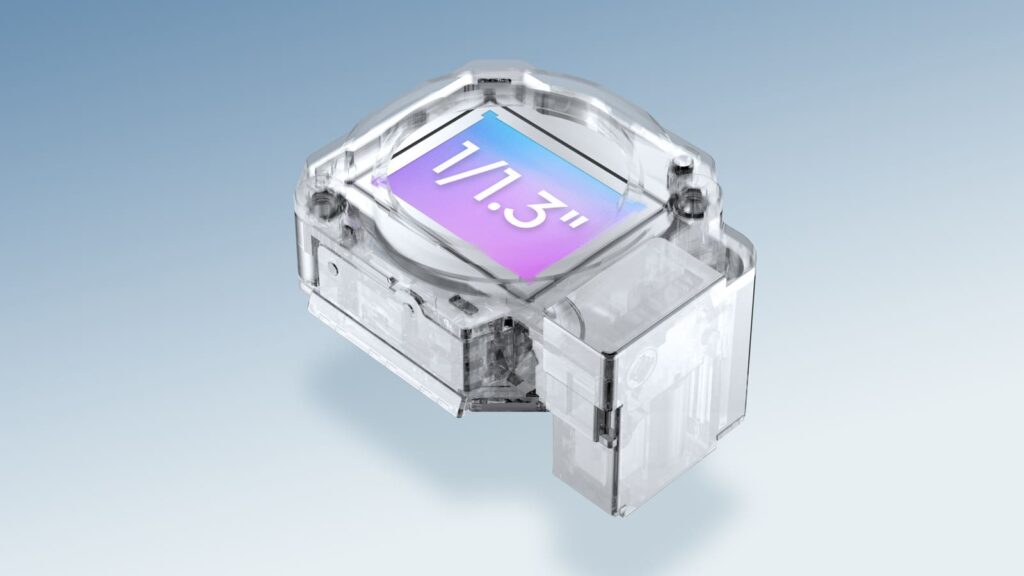
DJI Flip CMOS Sensor – souce: mynewsdesk
What a Bigger Sensor Actually Buys You in the Field
Sensor size sets a hard ceiling on how much light your drone can gather before you even open the app to check ISO. A larger sensor area means either larger individual pixels — which improves low-light sensitivity and dynamic range per pixel — or room for higher resolution without sacrificing per-pixel quality, and that trade-off is exactly why DJI can put 100 megapixels on the Mavic 4 Pro’s 4/3-inch sensor while the Mini 5 Pro’s 1-inch sensor tops out at 50. Neither approach is wrong; they’re built for different jobs.
Where this actually bites you is at golden hour and blue hour — the two windows where Ulm’s skyline, the Dolomites’ peaks, and Lake Como’s shoreline all look their best. A smaller sensor pushes its noise floor into view sooner as you compensate for falling light, and once you’re grading in post, that noise amplifies. I’ve had 1/1.3-inch footage from a Swabian Alps sunset shoot fall apart under a moderate shadow lift that a 1-inch sensor handled with room to spare.
⚠️ Warning: A higher megapixel count on a small sensor is not a substitute for sensor area. Smaller sensors packed with more megapixels have smaller individual photosites, which can actually reduce per-pixel low-light performance compared to a lower-resolution sensor of the same physical size.
The DJI Sensor Size Ladder, Explained
Every current DJI consumer and prosumer drone sits on one of five sensor tiers, and each step up roughly doubles the physical light-gathering area of the step below it.
| Sensor Size | Dimensions | Area | Found In |
|---|---|---|---|
| 1/2.3-inch | 6.17 × 4.55mm | ~28mm² | DJI Mini 4K, Mini 3 |
| 1/1.3-inch | 9.6 × 7.2mm | 69.1mm² | Mini 4 Pro, Air 3, Lito X1, Avata 2 |
| 1-inch | 13.2 × 8.8mm | 116.2mm² | Mini 5 Pro, Air 3S |
| 4/3-inch | 17.3 × 13.0mm | 224.9mm² | Mavic 3 Classic, Mavic 3 Pro, Mavic 4 Pro |
| Full frame | 35.9 × 23.9mm | 858mm² | Inspire 3 |
The jump from 1/1.3-inch to 1-inch is a 68% increase in sensor area. The jump from 1-inch to 4/3-inch is another 94% increase. Neither of those is a marginal spec bump — each step is close to doubling the amount of light the camera physically captures, which is why the difference between a Mini 4 Pro and a Mavic 4 Pro shows up immediately in shadow recovery, not just on paper.
Sensor size also drives crop factor — how much narrower your field of view is compared to the same focal length on a full-frame camera. A 1-inch sensor has a crop factor of roughly 2.7×, so a drone’s 24mm-equivalent lens actually behaves closer to a 65mm lens in terms of framing. A 4/3-inch sensor’s crop factor drops to around 2.0×, giving a noticeably wider effective field of view at the same stated focal length — worth knowing before you plan a shot that depends on getting the whole facade or coastline in frame.
Which Sensor Size Fits Your Shooting Plans
If You're a Hobbyist Buying Your First Serious Drone
You’re weighing crash risk, EU paperwork, and price against wanting footage that doesn’t look like everyone else’s Mini 3 clips. A 1-inch sensor in a sub-250g body — currently only the Mini 5 Pro offers this — gets you the biggest quality jump available without moving into a heavier registration class. It’s the rare case where you don’t have to trade portability for image quality.
If You Sell Stock Footage
Licensing platforms reward resolution and cropping flexibility over pure low-light performance, since most stock buyers grade for daylight or golden-hour delivery, not night work. A 1-inch or 4/3-inch sensor at high megapixel counts gives you room to crop for vertical and square deliverables from the same 4K master — a real advantage when one flight needs to service five different licensing formats.
If You're a Pro Pilot Building a Client-Facing Business
Client work — real estate, hospitality, corporate video — lives or dies on dynamic range in mixed lighting: bright sky, shaded facade, interior windows all in one frame. A 4/3-inch sensor with 14 stops of dynamic range and variable aperture removes the need to carry and swap ND filters mid-shoot, which matters more than people expect once you’re on a paid timeline with a client watching. I run this exact trade-off through my own drone videography bookings across Ulm and the wider Southern Germany market.
The EU Weight Class Trade-Off
Bigger sensors add weight, and in the EU that weight can move your drone into a different open-category class with its own registration and pilot-licence requirements. A 1-inch sensor in a sub-250g airframe — the Mini 5 Pro — currently sidesteps that trade-off entirely, which is part of why it’s the first drone of its kind. Step up to a 4/3-inch sensor on a Mavic-class drone and you’re carrying more weight, which changes which category applies to your flight.
I hold both the EU Kompetenznachweis (A1/A3) and the Fernpilotenzeugnis (A2), so I fly across multiple weight classes regularly — the paperwork difference between them is real, and it’s worth understanding before your sensor choice pushes you into a heavier bracket you didn’t plan for. Our Drone Laws & Regulations guide breaks down the exact weight thresholds and licence requirements for EU pilots in full.
See Your Shortlist to Scale in the Free Comparator Tool
Everything above is the theory — the Drone Sensor Comparator is where you actually apply it to the two or three drones you’re deciding between. Select your shortlist, filter by what you shoot (Timelapse, Low Light, Cinematic, Stock Footage, or Travel), and see the sensors rendered to true physical scale instead of guessing from a fraction on a spec sheet.
Stop Guessing at Fraction Labels. See the Actual Sensor.
Compare sensor size, dynamic range, and filmmaker score side by side — and know exactly what you are trading before you upgrade.
Read Next on Aero Timelapse
- Free Drone Sensor Comparator — compare up to four DJI drones’ sensors to true scale with filmmaker-specific scoring.
- DJI Lito X1 vs Mini 5 Pro — a direct head-to-head between the two sub-250g options mentioned above.
- DJI Mavic 4 Pro vs DJI Air 3S — where the 4/3-inch upgrade actually pays off for pro work.
- DJI Lito X1 Review — full hands-on breakdown of DJI’s new entry-level line.
- DJI Air 3S Review — full review of the drone recommended above for stock sellers.
- DJI Mavic 4 Pro Review — is DJI’s flagship sensor worth it for professional work?
- Drone Laws & Regulations — EU Pilots (2026) — the weight-class breakdown referenced above.
- Depth of Field Calculator — see how your sensor choice affects focus and hyperfocal distance.
- ND Filter Calculator — essential once you’ve picked a fixed-aperture sensor and need to control exposure manually.
- Best Drones: Complete Buyer’s Guide (2026) — the wider buying framework this article’s sensor section feeds into.
- Best Professional Drones 2026: Cinema & Commercial Grade — for pro pilots ready to move past consumer sensor sizes entirely.
FAQ - Why Sensor Size Matters?
What is the most important spec when buying a drone?
Sensor size is the spec with the biggest measurable impact on image quality, since it directly determines how much light the camera captures — but it isn’t the only factor. Weight, EU registration class, and price tier all interact with sensor size, so the “right” spec depends on matching sensor area to your actual use case rather than chasing the single biggest number.
Do I need a 1-inch sensor for real estate or tourism drone video?
For most daylight real estate and tourism shoots, a 1/1.3-inch sensor is genuinely sufficient, since these shoots rarely push into extreme low light. A 1-inch sensor — like the one in the DJI Air 3S — becomes worth the extra cost once dusk shots, interior-to-exterior exposure blending, or client delivery in 4K HDR are part of the brief.
Does a bigger drone sensor always mean a heavier drone?
Generally yes — larger sensors require larger lens assemblies and more substantial camera housings, which adds weight to the airframe. The DJI Mini 5 Pro is the current exception, packing a 1-inch sensor into a sub-250g body that previously only housed 1/1.3-inch or smaller sensors.
Can I sell stock footage shot on a small-sensor drone?
Yes — most stock platforms accept footage from 1/1.3-inch sensors without issue, since licensing decisions weight resolution, composition, and usability over raw sensor area. That said, a 1-inch sensor’s extra dynamic range and cropping headroom does make grading and reformatting for multiple deliverables noticeably easier, which is where sensor size pays off for volume stock sellers specifically.
The Bottom Line
Understanding why sensor size matters will tell you more than an hour of reading spec sheets. Stop comparing drones by megapixel count or by a fraction that doesn’t describe a physical size. Look up the actual sensor dimensions in millimetres, understand that each step up the sensor ladder roughly doubles the light-gathering area of the step before it, and match that jump to what you actually shoot — not to whichever number is printed biggest on the box. When you’ve got a shortlist, run it through the free Drone Sensor Comparator to see it to scale, and if you’d rather talk through the decision against a real client brief, get in touch and I’ll help you land on the right setup.
Dipon is a drone and timelapse cinematographer based in Ulm, Germany, with over 15 years of experience turning real spaces and projects into cinematic visuals. With a background in digital marketing, every shot is planned with a clear purpose — where it will appear, who will see it, and what it should help them decide.
You May Also Like
How Weather Affects Timelapse & Drone Shoots
DJI Lito X1 vs Mini 5 Pro: Which Ultralight Drone Belongs in Your Camera Bag?
DJI Mavic 4 Pro vs DJI Air 3S
DJI Air 3S Review: The Sweet-Spot Drone for Creators and Professionals
DJI Mavic 4 Pro Review: Is It Worth It for Professional Work? (2026)

Best Prime Week Drone Deals for Creators and Beginners
Drone Laws & Regulations — The Complete Legal Guide for EU Pilots (2026)

Best Timelapse Cameras Under €1,000 in 2026

DJI Lito X1 Review: The Ultimate Pocket-Sized B-Cam for Creators?
Best Time to Fly a Drone for Photography
DJI Flip vs DJI Neo 2: Which Pocket Drone is Better for Travel Creators?
Best Travel Drones 2026: The Complete Buying Guide
Need help capturing aerials for your next project but not ready to invest in the gear yet? Check out our Drone Videography to see how Aero Timelapse Studio can help elevate your production.