DJI Air 3S Review: The Sweet-Spot Drone for Creators and Professionals
Dipon | July 2026
Table of Contents
- Where the DJI Air 3S Fits in DJI’s Lineup?
- Camera System and the Aperture Gap
- Low-Light Performance and LiDAR Obstacle Avoidance
- Battery Life: Rated vs. Real-World
- Transmission Range and Wind Resistance
- DJI Air 3S vs. DJI Mavic 4 Pro: Verified Numbers
- Is It Worth It for a Stock Footage Catalogue
- Gear and Recommendations
- FAQ
- Conclusion
Affiliate Disclosure
This guide contains affiliate links. Purchases made through these links support Aero Timelapse Studio at no additional cost to you. I only recommend products I personally use or carefully research. As an Amazon Associate I earn from qualifying purchases.
Before the spec sheet wins you over, know this: the DJI Air 3S has no variable aperture. Neither camera can stop down past its fixed setting, so every bright-daylight shoot demands an ND filter — otherwise you’re stuck with a shutter angle that doesn’t match your frame rate. One tier up, the Mavic 4 Pro solves this with a f/2.0–f/11 variable aperture on its main lens. That’s the tradeoff you’re accepting at this price point.
Past that limitation, the Air 3S is a 724 g dual-camera drone built around a 1-inch main sensor and DJI’s first forward-facing LiDAR module in this weight class. I flew it across the Swabian Alps, over Lake Como, and on two paid shoots in the Dolomites, running it alongside a Mavic 4 Pro for direct comparison. Here’s what it actually changes for someone who wants professional-feeling results without carrying professional-tier complexity or cost.
Key Takeaways
- The Air 3S pairs a 1-inch, 50MP wide sensor with a 1/1.3-inch, 48MP 70mm tele camera, both rated to 14 stops of dynamic range in Auto mode.
- Neither camera has a variable aperture. You’ll need an ND filter set for daylight video work — budget for it before you buy.
- Forward-facing LiDAR measures obstacles from 0.5–18 m and detects them out to 200 m, extending safe flying into dusk where the older Air 3’s vision-only sensors struggle. It’s rated for scenes above 1 lux with visible texture — it is not a 0.1-lux system like the Mavic 4 Pro’s.
- DJI rates flight time at 45 minutes; DJI’s own controlled hover test measured 41 minutes; real-world flying puts most pilots at 30–38 minutes per battery.
- German DJI Store pricing: €1,099 (standard kit, RC-N3), €1,399 (Fly More Combo, RC-N3), €1,599 (Fly More Combo, RC 2).
- At 724 g, the Air 3S sits in the EU’s Open category C1/C2 weight bracket — registration and remote ID apply on every flight, regardless of intent.
- For stock footage sellers, the 1-inch sensor and dual-focal-length coverage are the actual value driver. The LiDAR is a safety-margin feature your buyers will never see in the licensed clip.
Where the DJI Air 3S Fits in DJI's Lineup?
The DJI Air 3S exists to close the gap between DJI’s ultralight Mini-series drones and the Mavic 4 Pro’s price and sensor size — a mid-tier drone built around a 1-inch sensor and real obstacle avoidance, not just an incremental camera bump on the previous Air 3. Released in late 2024 and refreshed in early 2026 with a forward-facing LiDAR module, it’s the first drone in the Air series to bring LiDAR-assisted obstacle sensing down from the Mavic line. The full spec sheet is above in Key Takeaways, so it won’t be repeated here. What matters is the positioning: this is the drone DJI built for someone whose stock catalogue or client work has outgrown a Mini-series sensor, but whose budget hasn’t reached Mavic 4 Pro territory.
Camera System and the Aperture Gap
The wide camera’s 1-inch sensor is the real upgrade over the standard Air 3, which used two smaller 1/1.3-inch sensors. DJI raised the maximum ISO in normal color mode from 6,400 to 12,800, and to 3,200 in D-Log M and HLG — that shows up as cleaner shadow detail above ISO 3,200 in practice.
What DJI didn’t add: a variable aperture. Both cameras on the Air 3S are fixed-aperture. Reviewers have flagged this specifically as a limitation for videographers who want shallow depth-of-field control or need to manage exposure in bright daylight without stacking ND filters. The Mavic 4 Pro’s main camera, by contrast, has f/2.0–f/11 variable aperture built in — one of the reasons it costs roughly double. If you want to compare the Air 3S’s sensor against the rest of DJI’s lineup before deciding whether that trade-off is worth it, our free Sensor Comparator puts them side by side to true scale.
⚠️ Warning: Don’t buy the Air 3S expecting to skip ND filters. Budget for a set from day one; shooting 4K video at a correct 180-degree shutter angle in daylight isn’t optional if you want gradeable, licensable footage.
Low-Light Performance and LiDAR Obstacle Avoidance
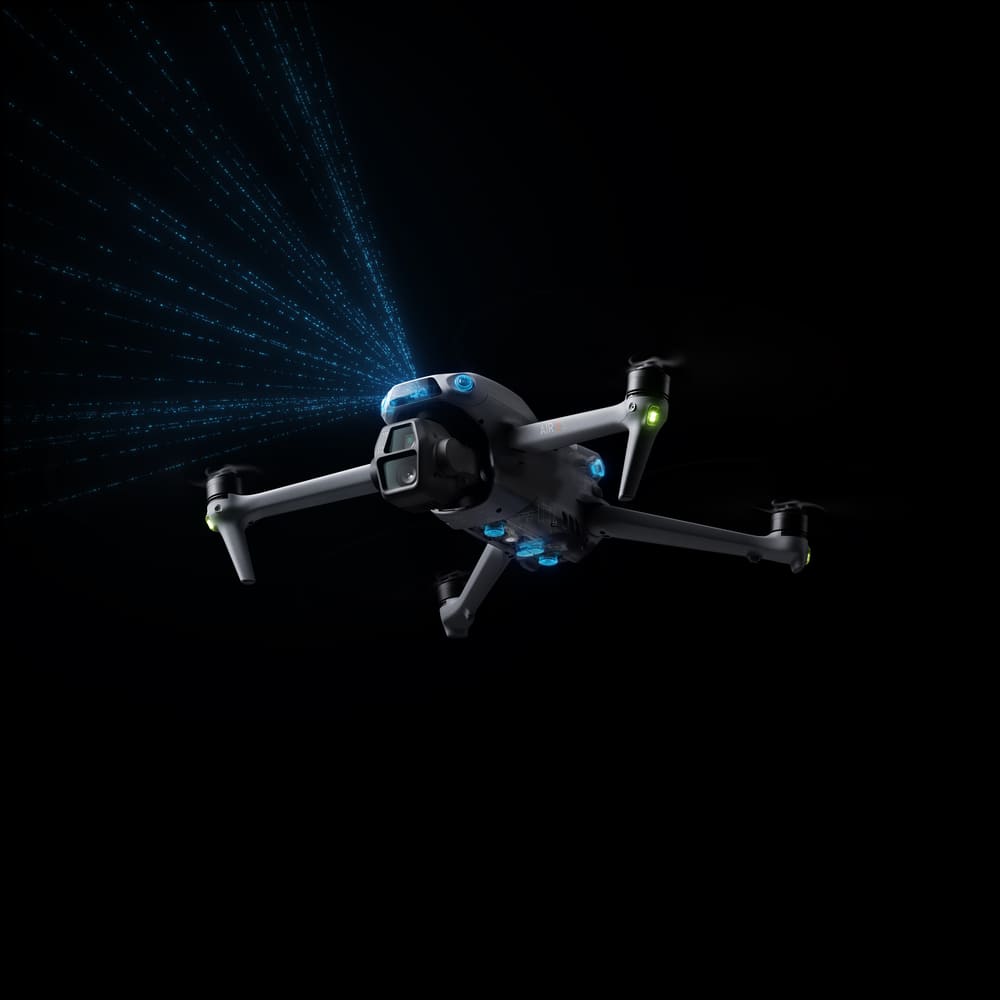
DJI’s forward-facing LiDAR measures obstacle distance from 0.5 to 18 meters and detects obstacles out to 200 meters, working alongside the omnidirectional vision system and a downward infrared time-of-flight sensor. This is a genuine upgrade over the standard Air 3, which relied entirely on vision-based sensors with no LiDAR at all — meaning obstacle detection dropped off sharply whenever contrast or light was poor. The LiDAR closes that gap by measuring physical distance directly rather than inferring it from image contrast, which is why it holds up in conditions that would confuse a vision-only system. The important caveat, from DJI’s own documentation: nightscape obstacle sensing only works on surfaces with discernible texture and in lighting above 1 lux. Flat, textureless surfaces — smooth water, a plain wall, a foggy sky — will still defeat it, and DJI also caps effective sensing speed at roughly 15 m/s, so fast forward flight can outrun the system’s ability to react in time.
That 1-lux threshold is a real ceiling, not a rounding difference. The Mavic 4 Pro’s six low-light fisheye sensors are rated to 0.1 lux — ten times more sensitive — which is the gap between “safe until early dusk” and “safe well into true darkness.” In practical terms, the Air 3S is built to extend your working window from daylight into blue hour, not to make true night flying safe. I tested the Air 3S’s limit directly on a blue-hour shoot near Hohenzollern Castle: obstacle sensing held reliably on the tree line and the castle’s stone walls, both of which gave the LiDAR clean, textured surfaces to read, right up to the point DJI’s own spec sheet predicts it should start to degrade. Past that light level, vision-only fallback took over and the drone’s obstacle warnings became noticeably less confident — exactly the behavior you’d expect once ambient light drops below the LiDAR’s rated threshold. That transition is worth knowing before you fly a real job on this drone: plan dusk shoots to wrap before that threshold, not after it.
source: mynewsdesk.com
💡 Pro Tip: Fly a daylight pass over any route you plan to shoot at dusk before you rely on the LiDAR for it. The system extends your margin — it doesn’t replace knowing the terrain.
Battery Life: Rated vs. Real-World
DJI rates the Air 3S at 45 minutes of flight time. DJI’s own controlled hover test — no wind, sea level, Obstacle Avoidance set to Brake, photo mode, 100% to 0% — measured 41 minutes. Independent reviewer testing in real flying conditions consistently lands at 30–38 minutes per battery, which matches what I got flying the Swabian Alps in a light 4–5 m/s breeze.
The 247 g intelligent battery charges in about 80 minutes with the 65W portable charger, or 60 minutes with the 100W USB-C adapter. The Fly More Combo’s charging hub includes a power-accumulation feature that transfers remaining charge from lower batteries into your highest one — useful mid-session, since it means topping off one battery from the scraps of two nearly-dead ones instead of a full charge cycle.
Transmission Range and Wind Resistance
DJI’s German store lists a max O4 range of 20 km at 1080p/60fps for EU units, versus 32 km quoted in US-market wind tunnel tests. Both regions use the same O4 hardware; the gap comes down to EU transmission power limits under CE regulations versus the higher ceiling allowed under US FCC rules. In Alpine flying, this rarely matters in practice: terrain and ridgelines break line of sight long before you approach either figure, so geography — not transmission power — sets the real ceiling.
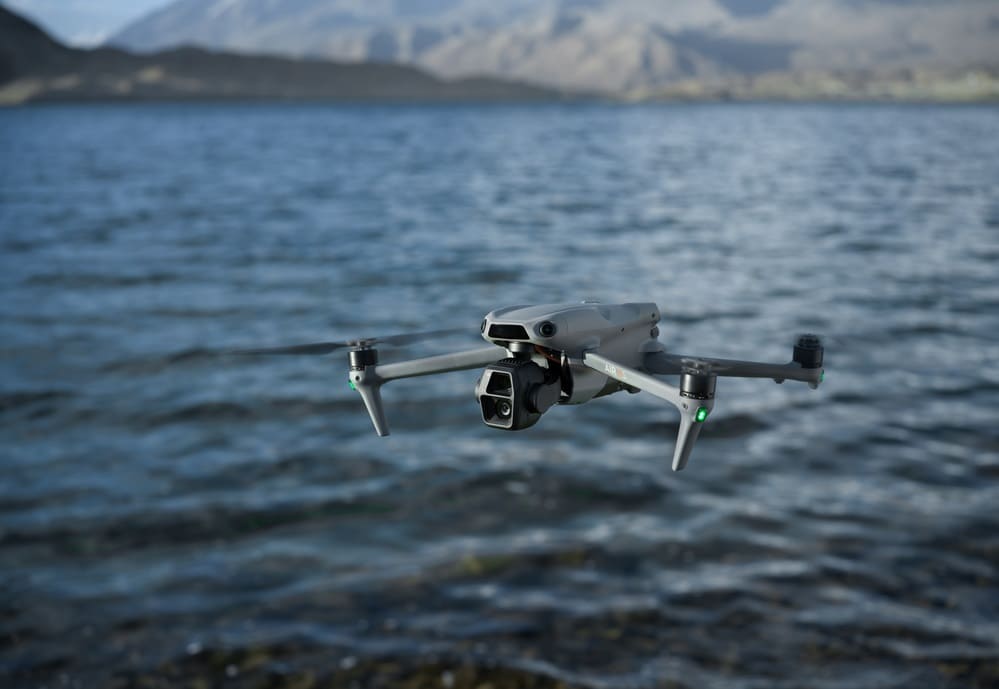
Wind resistance is rated at roughly 12 m/s, or Beaufort 6, and that held up in real conditions, not just controlled tests. Near Lake Como, where thermal winds accelerate over ridgelines, the 724 g airframe stayed stable through gusts that would push a lighter, sub-250g drone off its hover. The extra mass adds inertia against gusts, letting the flight controller compensate smoothly rather than fighting visible instability — which means more usable footage per flight rather than clips lost to wind jitter.
source: mynewsdesk.com
DJI Air 3S vs. DJI Mavic 4 Pro: Verified Numbers
| Spec | DJI Air 3S | DJI Mavic 4 Pro |
|---|---|---|
| Main sensor | 1-inch CMOS, 50MP, fixed aperture | 4/3-inch CMOS, 100MP Hasselblad, f/2.0–f/11 variable aperture |
| Camera count | 2 (wide + 70mm tele) | 3 (28mm wide + 70mm tele + 168mm tele) |
| Dynamic range | ~14 stops (Auto mode) | Not officially quoted; independent testing measured roughly ~1 stop more than Mavic 3 Pro in the same scene |
| Low-light obstacle sensing | Forward LiDAR + vision, 1-lux threshold | Six 0.1-lux fisheye sensors + forward LiDAR |
| Rated / real-world flight time | 45 min / 30–38 min | 51 min / 35–43 min |
| Wind resistance | ~12 m/s | ~12 m/s |
| EU transmission range (CE) | 20 km | 15 km |
| Weight | 724 g | ~1,063 g |
| Price | Check Price on Amazon | Check Price on Amazon |
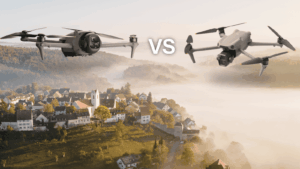
The Mavic 4 Pro wins on sensor size, resolution, aperture control, and low-light sensitivity — expected at roughly double the price. The one place the Air 3S wins outright is EU transmission range, a genuine surprise given the price gap and worth knowing if range matters more to your work than sensor size.
If your briefs increasingly call for telephoto compression, read the full DJI Mavic 4 Pro vs DJI Air 3S comparison before you commit to the Air 3S.
Is It Worth It for a Stock Footage Catalogue?
For a stock catalogue, the number that matters is the 1-inch sensor and its 14 stops of dynamic range, not the LiDAR. Stock buyers on Pond5, Adobe Stock, and Shutterstock are licensing the image, not the flight safety system; a clip shot with better shadow recovery and less noise at higher ISO clears technical review more reliably and grades into more delivery formats. The dual-camera system means you leave a location with both an establishing wide shot and a compressed 70mm detail shot — two distinct, licensable clips per battery cycle instead of one.
The aperture gap is the real cost of that value. Every daylight session needs an ND filter kit factored into the budget, and the fixed-aperture tele camera won’t give you the shallow depth-of-field look some buyers pay a premium for on cinematic stock clips. If your catalogue leans heavily on golden-hour and blue-hour landscape work where every extra stop of dynamic range and aperture control shows up in the final grade, the Mavic 4 Pro’s larger sensor and variable aperture will outperform this by a real margin — and at roughly double the price, that’s the actual tradeoff to weigh, not a soft caveat to skim past.
Pro pilots reading this for client work: the calculus flips. The LiDAR’s real 41-minute hover time and 1-lux obstacle sensing are what justify the Air 3S over the older Air 3 for dusk shoots — a real estate booking or evening Stadtfest job where vision-only sensing forces you to either finish manually with a spotter or walk away from the light. The 724 g weight still puts you in the EU’s C1/C2 registration bracket either way, so confirm that against your current setup before adding it to your kit. See our Drone Laws & Regulations guide for what that bracket actually requires.
Gear and Recommendations
If your work is weighted toward daylight and golden-hour shooting — travel content, landscape b-roll, or a stock catalogue built around well-lit conditions — the DJI Air 3S covers most of what you need. Its 1-inch sensor and dual-focal-length setup handle the majority of sellable and client-ready angles without Mavic-tier pricing.
Best for: creators and stock contributors whose catalogue leans on daylight and golden-hour landscape and travel footage.
If your output regularly extends into blue-hour, low-light, or higher-end commercial delivery — where extra dynamic range and aperture control directly affect what a client accepts or what sells — step up to the DJI Mavic 4 Pro. Its variable aperture removes the exposure ceiling the Air 3S runs into in those conditions.
Best for: pilots and stock sellers whose work is weighted toward golden-hour, night, and cinema-grade delivery.
One add-on applies regardless of which body you choose: an ND filter set for the Air 3S is close to mandatory for daylight work. Since neither Air 3S camera has a variable aperture, filters are the only way to hit a correct shutter angle in bright conditions — budget for this as part of the base kit, not an afterthought.
Read Next on Aero Timelapse
- Best Professional Drones 2026: Cinema & Commercial Grade — where the Air 3S sits relative to full cinema-grade options.
- Drone Buying Checklist (2026) — a step-by-step gut-check before you buy any drone in this price range.
- Best Drones for Photography 2026 — how the Air 3S ranks for stills work specifically.
- The Complete Drone Videography Guide (2026) — shooting technique once you own the drone.
- Best Drones: Complete Buyer’s Guide (2026) — this article’s parent pillar.
- DJI Mavic 4 Pro Review: Is It Worth It for Professional Work? (2026) — the direct upgrade comparison.
- Free Drone Weather Checker 🔧 — plan around the wind figures discussed above.
- Drone Battery Calculator 🔧— plan realistic session length using real-world, not rated, flight time.
- Drone Laws & Regulations — The Complete Legal Guide for EU Pilots (2026) — required reading for the 724g weight class.
- Golden Hour & Blue Hour Planner 🔧— plan the low-light sessions where the LiDAR upgrade actually matters.
- Best Travel Drones 2026: The Complete Buying Guide — the Air 3S is positioned as a travel drone.
- DJI Lito X1 Review — a sub-250g LiDAR-equipped competitor worth cross-referencing for weight-conscious readers.
- Best Time to Fly a Drone — pairs directly with the low-light/LiDAR discussion above.
- Drone Shot Planner & Pre-Flight Checklist 🔧— practical companion for planning the dusk shoots this drone is built for.
FAQ: DJI Air 3S Review
Is the DJI Air 3S worth buying over the standard DJI Air 3
If you fly regularly at dusk or in low-contrast conditions, yes — the LiDAR and 1-inch sensor are a real upgrade. If you shoot almost exclusively in daylight, the older Air 3’s current discounted pricing is the sharper value.
Does the DJI Air 3S have a variable aperture?
No. Both cameras on the Air 3S are fixed-aperture, which means you need an ND filter kit for correct exposure in daylight video. The Mavic 4 Pro’s main camera has f/2.0–f/11 variable aperture built in.
How long does the DJI Air 3S actually fly in real conditions?
Yes. At 724 g, it falls outside the EU’s sub-250g exemption and sits in the Open category’s C1/C2 weight bracket, which requires registration and remote ID broadcast on every flight.
Does the DJI Air 3S require registration in the EU?
Only the 512GB Creator Combo supports ALL-I encoding with 10-bit 4:2:2 color. The standard and Fly More Combo versions don’t include this.
Does the LiDAR on the DJI Air 3S work in complete darkness?
No. DJI’s specification limits nightscape obstacle sensing to surfaces with discernible texture and lighting above 1 lux. The Mavic 4 Pro’s six fisheye sensors are rated to 0.1 lux — a materially wider low-light margin.
Is the DJI Air 3S good for stock footage sales?
For daylight and golden-hour landscape and travel clips, yes — the 1-inch sensor and dual-camera coverage produce clean, gradeable, licensable footage. For catalogues weighted toward blue-hour and night material, the DJI Mavic 4 Pro’s larger sensor and variable aperture will outperform it by a real margin.
Conclusion
Buy the DJI Air 3S if your catalogue or client work is daylight and golden-hour, and budget for an ND filter kit on day one — that’s the real cost this review keeps circling back to. If your work depends on blue-hour and night material where dynamic range and aperture control directly affect what sells, skip straight to the Mavic 4 Pro review instead; the roughly €1,000 gap between them buys a sensor and aperture system this drone simply doesn’t have.
Dipon is a drone and timelapse cinematographer based in Ulm, Germany, with over 15 years of experience turning real spaces and projects into cinematic visuals. With a background in digital marketing, every shot is planned with a clear purpose — where it will appear, who will see it, and what it should help them decide.
You May Also Like
How to Shoot a Little Planet Photo With a Drone
Best Drones for Beginners (2026): Safe, Easy Picks + Buying Guide
Why Sensor Size Matters When You’re Buying a Drone
How Weather Affects Timelapse & Drone Shoots
DJI Lito X1 vs Mini 5 Pro: Which Ultralight Drone Belongs in Your Camera Bag?
DJI Mavic 4 Pro vs DJI Air 3S
DJI Mavic 4 Pro Review: Is It Worth It for Professional Work? (2026)

Best Prime Week Drone Deals for Creators and Beginners
Drone Laws & Regulations — The Complete Legal Guide for EU Pilots (2026)

Best Timelapse Cameras Under €1,000 in 2026
DJI Lito X1 Review: The Ultimate Pocket-Sized B-Cam for Creators?

Best Time to Fly a Drone for Photography
Need help capturing aerials for your next project but not ready to invest in the gear yet? Check out our Drone Videography to see how Aero Timelapse Studio can help elevate your production.