
Best Travel Drones 2026: The Complete Buying Guide
Dipon | May 2026
Table of Contents
- Why “Best Travel Drone” Is a Different Question Than “Best Drone”
- Comparison Table
- EASA Regulations for EU Travellers in 2026: What You Actually Need to Know
- The 4 Best Travel Drones of 2026: Complete Breakdown
- What to Pack: The Complete Travel Drone Kit Checklist
- Read Next on Aero Timelapse
- Frequently Asked Questions
- Conclusion: The Light Is Already Changing
Affiliate Disclosure
This guide contains affiliate links. Purchases made through these links support Aero Timelapse Studio at no additional cost to you. I only recommend products I personally use or carefully research. As an Amazon Associate I earn from qualifying purchases.
You’re standing in line at Stuttgart Airport with a carry-on that’s already 1 kg over limit, and your drone bag is technically a second personal item you’re hoping no one notices. I’ve been there — and I’ve also been the person who brought the wrong drone to Lake Como and spent two hours watching a 250g weight limit ruin every plan I’d made for the morning. The drone market in 2026 has never been better, but “best travel drone” means something very specific: it has to pack small, comply with EASA regulations across EU countries, survive weather you didn’t plan for, and still deliver footage you’re actually proud of. In this guide I’ll walk you through exactly which drones deliver on all four of those things — and which ones look great on paper but will slow you down the moment you leave home.
Quick Answer: What's the Best Travel Drone in 2026?
The DJI Mini 5 Pro is the best travel drone for most people in 2026. It weighs 249.9g — just under the EU’s 250g EASA C0 threshold — which means fewer registration headaches across Europe and open-category flying in most destinations. It carries a 1-inch 50MP sensor that matches the image quality of drones twice its size, shoots 4K/60fps, and folds down to roughly the size of a water bottle. For travellers who want more wind resistance, a dual-camera system, and 45-minute flight times, the DJI Air 3S Fly More Combo is the step up worth paying for. Budget travellers who want to stay sub-250g (EASA C0) without paying Mini 5 Pro prices should look at the DJI Lito X1 — launched April 2026 at €419, it’s the most capable entry-level travel drone under €500, and it carries the same C0 regulatory advantage as the Mini 5 Pro. Start with the Mini 5 Pro — and only go bigger if you know you need it.
Why "Best Travel Drone" Is a Different Question Than "Best Drone"
A drone that’s incredible in a studio or on a planned commercial shoot can be a nightmare for travel. The DJI Mavic 4 Pro is, technically, one of the best drones you can buy in 2026 — but it needs its own dedicated backpack, draws attention at airport security, and weighs over 950g. For a weekend in the Swabian Alps or a ten-day trip through the Dolomites, that tradeoff makes no sense.
The four pillars of a genuine travel drone are: weight (under 250g is a legal advantage in most EU countries), packability (does it fit in a day bag without a dedicated case?), EU compliance (EASA Open Category classification, CE marking, and operator registration), and image quality (a 1-inch sensor is the minimum worth packing in 2026).
One number dominates everything else: 250 grams. Under that threshold, EASA classifies a drone as C0 — and in most EU member states, that means simplified registration, no mandatory pilot competency certificate for recreational flying, and the ability to fly in Open Category A1 (over people, but not crowds). The moment you cross 250g, you’re in C1 territory: mandatory LBA (Germany) or equivalent national registration, a required A1/A3 online training course, and far tighter restrictions in national parks, near airports, and over populated areas.
💡 Pro Tip: Even sub-250g drones require registration in some EU countries for commercial use. If you’re monetising footage — including stock sales — register your operator ID with the LBA regardless of drone weight. It takes 20 minutes and costs nothing.
Best Travel Drones 2026 — Comparison Table
| Drone | Weight | Sensor | Max Flight | Wind Resistance | EU Class | Price |
|---|---|---|---|---|---|---|
| DJI Mini 5 Pro | 249.9g | 1-inch / 50MP | 36 min | 12 m/s | C0 | Check Price |
| DJI Air 3S | 723g | 1-inch (dual) | 45+ min | 14 m/s | C1 | Check Price |
| DJI Lito X1 | <249g | 1/1.3-inch / 48MP | 36 min | ~10 m/s | C0 | Check Price |
| DJI Lito 1 | <249g | 1/2-inch / 48MP | 36 min | ~10 m/s | C0 | Check Price |
EASA Regulations for EU Travellers in 2026: What You Actually Need to Know
Flying across EU borders is legally simpler than most people expect — but it still requires preparation. EASA’s Open Category framework applies across all EU member states, meaning your German LBA operator registration is valid in Austria, France, Italy, Spain, and every other EU country. You do not need separate national registrations for each country.
Here’s the practical breakdown for 2026:
| Drone Weight | EASA Class | Registration | Training Required | Where You Can Fly |
|---|---|---|---|---|
| Under 250g (e.g. Mini 5 Pro) | C0 | Optional for hobby, mandatory for commercial | None (recreational) | Open A1 — over people, not crowds |
| 250g–900g (e.g. Air 3S) | C1 | Mandatory | A1/A3 online course | Open A1 (with limits) / A2 with A2 CofC |
| 900g–4kg | C2 | Mandatory | A2 CofC certificate | Open A2 with restrictions |
⚠️ Warning: Several popular destinations — including many Italian national parks, Slovenian protected areas, and French coastal zones — have local flying bans that go beyond EASA’s baseline rules. Always check the local CAA or use the official EASA Drone Apps before flying in a new country. Getting grounded by a park ranger is not the memory you want from the Cinque Terre.
Switzerland, Norway, and Iceland are not EU members but have adopted EASA frameworks. If you’re heading to non-EU destinations — Morocco, Turkey, Georgia — regulations vary dramatically and you need country-specific research.
The 4 Best Travel Drones of 2026: Complete Breakdown
DJI Mini 5 Pro — Best Overall Travel Drone
The DJI Mini 5 Pro is the drone that finally removed the compromise between portability and professional image quality. Launched in September 2025, it squeezes a full 1-inch 50MP CMOS sensor — identical in size to the one in the Air 3S — into a 249.9g package. That single fact changes everything for EASA-aware European travellers.
Key specs:
- Weight: 249.9g (EASA C0)
- Sensor: 1-inch CMOS, 50MP
- Video: 4K/60fps, 10-bit D-Log M
- Flight time: up to 36 minutes
- Wind resistance: Level 6 (up to 12 m/s)
- Obstacle avoidance: Omnidirectional (front LiDAR + fisheye lenses)
- Transmission: 20km OcuSync 4
- Gimbal: 225° rotation — true vertical shooting for social media
The 225° gimbal rotation isn’t a gimmick — if you’re shooting Reels or Shorts from the Swabian Alps or the Gesäuse, native vertical framing at altitude is genuinely useful and previously required a DJI Flip or a crop in post. The front-facing LiDAR means obstacle avoidance works in complete darkness, which matters when you’re getting up before sunrise to catch the Aach fog burning off the valley floor.
I spent a morning in October shooting the Hohenzollern ridge with the Mini 5 Pro — overcast, 8°C, patchy fog at 860m. The footage held up in every condition I threw at it, and the whole kit fit in the side pocket of a hiking daypack. That’s the thing no spec sheet tells you: this drone goes places you’d never bring a C1-class drone, because it weighs the same as a water bottle and nobody asks you to fill out paperwork before you launch.
One real limitation to know upfront: above 2,500m in thin Alpine air, the Mini 5 Pro’s motors work harder and real-world flight time drops noticeably — budget 20 minutes per battery in the Ötztal or at altitude in the Berchtesgaden Alps, not 36. In sustained wind above 10 m/s, it’s flying but it’s working. If your travel itinerary includes exposed ridgelines in autumn or winter, the Air 3S section below is the honest answer.
For the traveller who wants to stay under 250g without sacrificing image quality, I recommend the DJI Mini 5 Pro Fly More Combo with RC 2 — the Fly More Combo adds two extra batteries (total of three) and a charging hub, which is critical for full-day travel shoots.
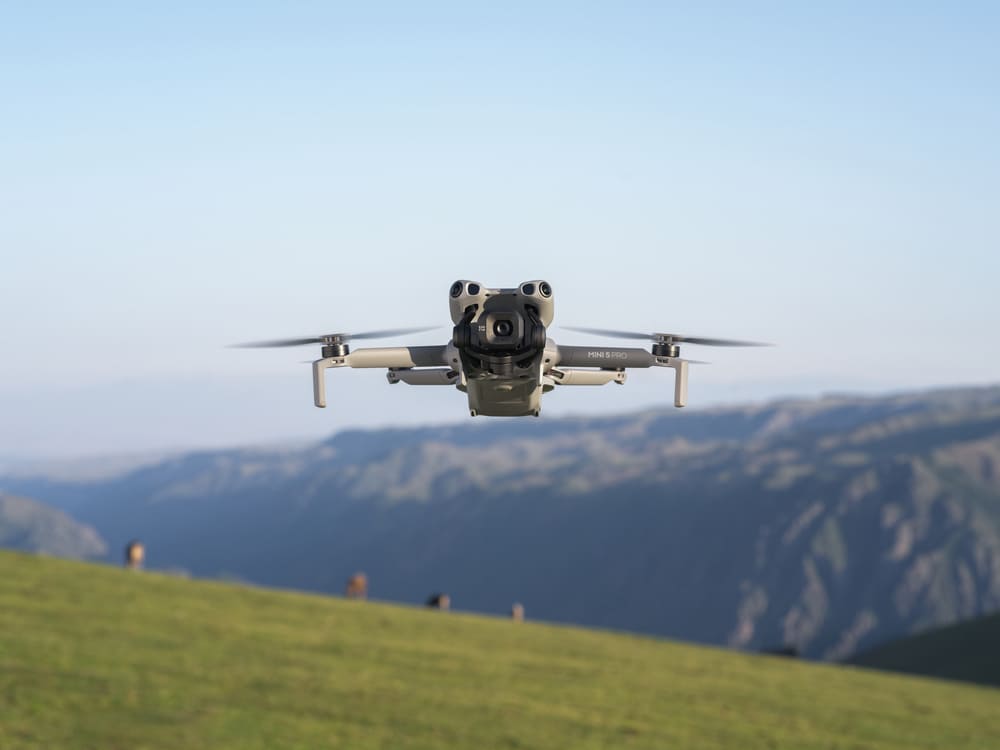
DJI Mavic 5 Pro – souce: mynewsdesk
Best for:
Hobbyist travellers, social media creators, anyone flying frequently across EU borders.
DJI Air 3S Fly More Combo — Best for Wind, Weather & Dual Camera
The DJI Air 3S is the drone to reach for when you know conditions won’t cooperate. I’ve shot timelapse with it on the exposed southern ridge above Lake Como in November — gusts hitting 11 m/s, temperature dropping through the afternoon — and the Air 3S locked position and kept the horizon dead level for two hours without a single dropped frame. The Mini 5 Pro would have been fighting the whole time.
Key specs:
- Weight: 723g (EASA C1 — registration + A1/A3 training required)
- Sensor: 1-inch CMOS (wide) + 1/1.3-inch (70mm tele)
- Video: 4K/60fps, 6K/30fps, 10-bit D-Log M
- Flight time: 45+ minutes
- Internal storage: 42GB (no SD card anxiety)
- Wind resistance: Level 7 (up to 14 m/s)
- Obstacle avoidance: Omnidirectional LiDAR + vision sensors
The 42GB internal storage is genuinely underrated. I’ve lost an SD card once in a mountain hut in the Allgäu — once is enough. For timelapse work, use the ND Filter Calculator to dial in the right glass before you set up a hyperlapse over Hohenzollern Castle.
The honest trade-off: the Air 3S is a 723g C1-class drone, which means it draws attention at airport security, requires your A1/A3 certificate on every flight, and makes EU national park exclusions harder to work around. You’ll be pulling it out of a dedicated bag, not a daypack pocket. That’s a real cost for casual travel — only pay it if you genuinely need the dual camera, the wind rating, or the longer flight time.
For conditions above 10 m/s, longer shoot days, or any work requiring the 70mm tele, the DJI Air 3S Fly More Combo is the right tool. The three-battery bundle with a charging hub effectively doubles your usable day.
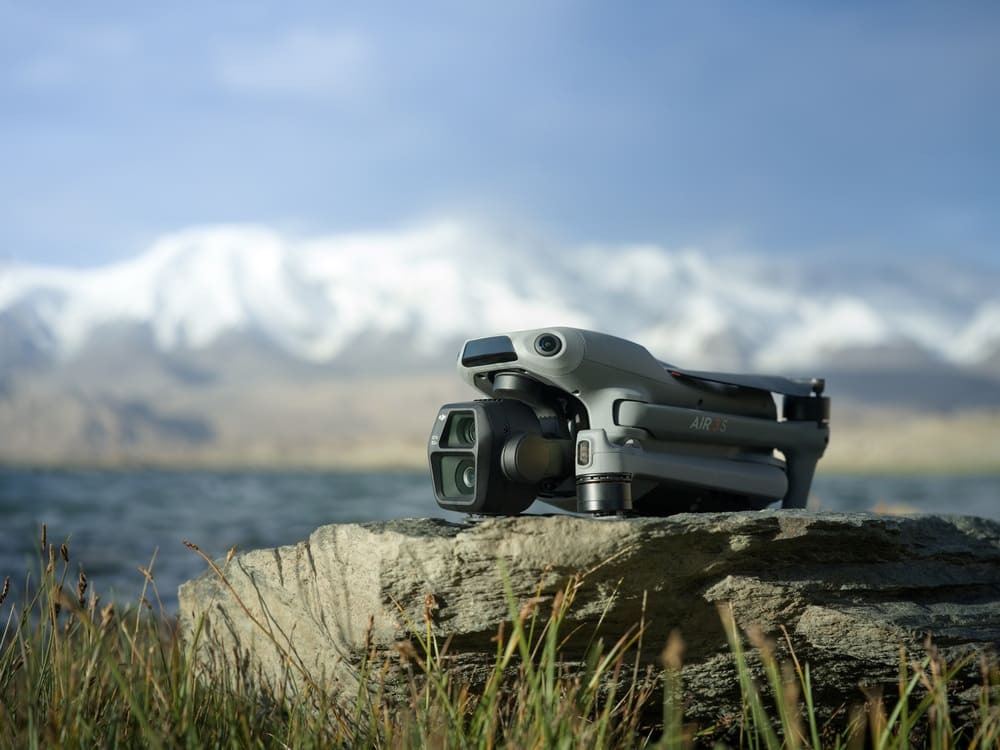
DJI Mavic 4 Pro – souce: mynewsdesk
Best for:
Dedicated travel photographers, timelapse creators, European landscape work in variable conditions.
DJI Lito X1 — Best Budget Travel Drone Under €500 (C0)
The DJI Lito X1, launched April 23, 2026, changes the budget travel drone conversation entirely. It weighs under 249g — EASA C0, same as the Mini 5 Pro — which means no mandatory A1/A3 training, simplified registration, and the ability to fly over uninvolved people in most EU locations. That regulatory advantage alone makes it a more compelling travel drone than the DJI Flip, which at ~300g sits in C1 territory and requires the full registration and training stack.
Key specs:
- Weight: under 249g (EASA C0 — no mandatory training for recreational use)
- Sensor: 1/1.3-inch CMOS, 48MP
- Video: 4K/60fps, 10-bit D-Log M
- Flight time: up to 36 minutes (real-world: ~25 minutes)
- Internal storage: 42GB + microSD slot
- Obstacle avoidance: Omnidirectional vision + forward-facing LiDAR
- Transmission: 20km OcuSync 4
The 42GB internal storage on a sub-€500 drone is surprising — it’s the same capacity as the Air 3S, and it means one less thing to lose in a mountain hut. The 10-bit D-Log M support at this price point is equally unexpected; it gives you real colour grading headroom in post, not just a flat profile in name only. Reviewers across Europe have called it the best-value beginner drone on the market right now, and on paper it’s hard to argue.
The honest limitation: the 1/1.3-inch sensor is a real step down from the Mini 5 Pro’s 1-inch in low light and golden hour conditions. For dawn shoots over the Aach valley or dusk at Hohenzollern, you’ll see the difference. For daytime travel content — mountain passes, coastlines, city skylines — it’s excellent.
For the best sub-€500 travel drone available in Europe right now, the DJI Lito X1 Fly More Combo — 42GB storage, forward LiDAR, 10-bit D-Log M, and full EASA C0 status.
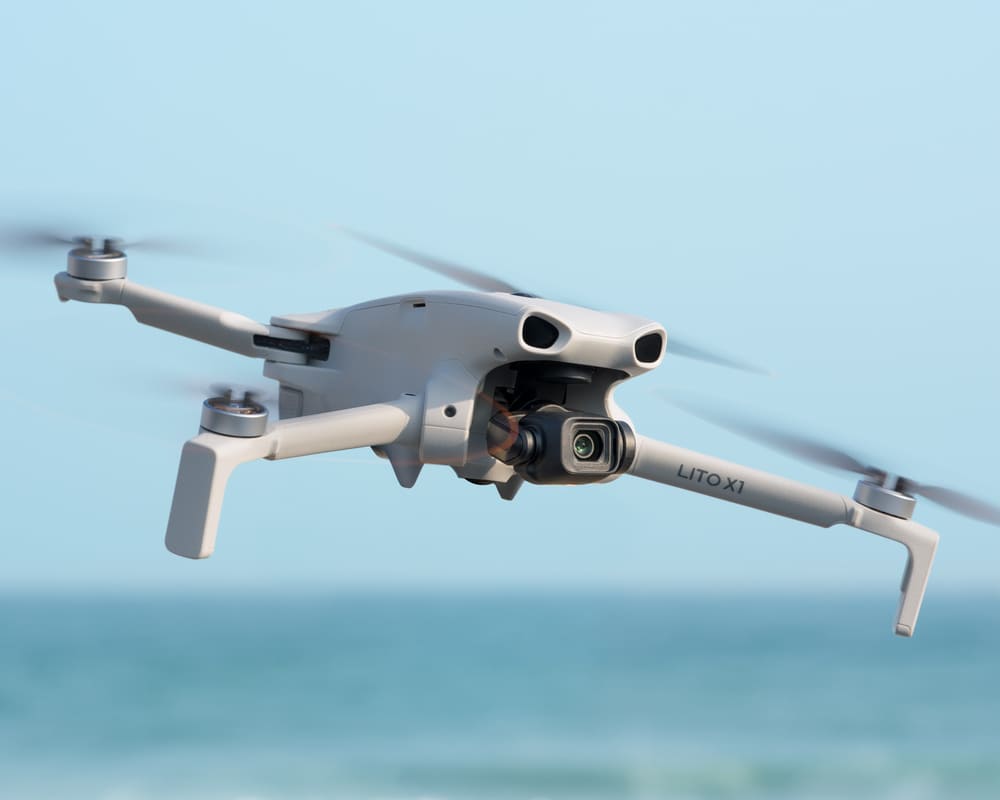
DJI Mavic 4 Pro – souce: mynewsdesk
Best for:
First-time buyers and budget-conscious travellers who still need the C0 regulatory advantage across EU borders.
DJI Lito 1 — Best True Entry Point Under €350
If your budget is firm and the Lito X1 feels like a stretch, the DJI Lito 1 is the most capable drone available under €350 in Europe. It shares the Lito X1’s sub-250g EASA C0 class, 36-minute flight time, omnidirectional obstacle avoidance, and overall flight quality — the difference is a smaller 1/2-inch sensor (no 10-bit D-Log M), no internal storage (microSD only), and no forward LiDAR.
Key specs:
- Weight: under 249g (EASA C0)
- Sensor: 1/2-inch CMOS, 48MP
- Video: 4K/60fps
- Flight time: up to 36 minutes
- Internal storage: None (microSD only)
- Obstacle avoidance: Omnidirectional vision sensors
For casual travel — day trips through Bavaria, a weekend in Prague, summer coastlines in Croatia — the Lito 1’s image quality is perfectly usable. Between 9am and 4pm in good light, the 1/2-inch sensor produces clean, sharp 4K footage that looks excellent on any screen and holds up fine for social media at full resolution. The limitations only show up at the edges: shoot into a backlit Adriatic sunset or try to pull detail from shadows in a narrow Bavarian alley at dusk, and you’ll see the sensor struggling where the Lito X1 or Mini 5 Pro would hold it together.
The practical workflow for the Lito 1 on a trip is simple — shoot between 8am and 5pm whenever possible, expose for the sky and let the ground fill in, and don’t push the ISO above 400. Within those constraints, it punches well above its €339 price tag. It’s not the drone for low-light landscape work or serious timelapse, but it’s a genuinely capable first drone that keeps you C0, keeps you light, and won’t saddle you with paperwork the moment you land in a new country. A lot of people buy more drone than they actually need on their first trip — the Lito 1 is the honest answer for anyone who isn’t sure yet how much they’ll actually fly.
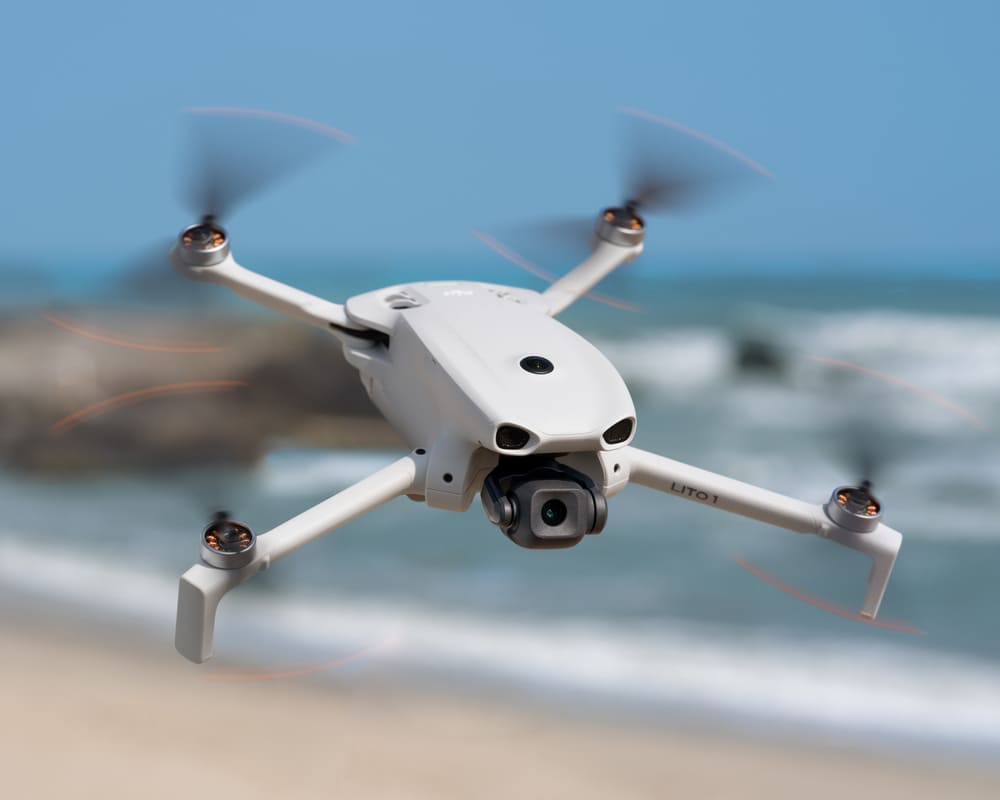
DJI Mavic 4 Pro – souce: mynewsdesk
Best for:
First-time buyers and budget-conscious travellers who still need the C0 regulatory advantage across EU borders.
What to Pack: The Complete Travel Drone Kit Checklist
You can fit a complete Mini 5 Pro travel kit in a 5L pouch inside a day bag. Here’s the exact list:
- Drone: Get the one that best fits your purpose.
- Batteries: Minimum 3. The Fly More Combo is not optional if you’re shooting all day — real-world flight time is 25–28 minutes in moderate wind, not the 36-minute spec figure
- ND filter set: ND4/8/16/32 minimum. Circular polariser for water reflections over Lake Como or the Ammersee
- Charging hub: Charges all three batteries sequentially from one USB-C cable — a single Anker 65W GaN charger powers everything
- Spare microSD card: 256GB minimum. On a full RAW timelapse day with the Mini 5 Pro shooting 50MP stills, 128GB fills faster than expected — use the Drone Storage Calculator to calculate exactly how much storage your shoot needs
- Hard case or protective pouch: Anything rigid enough to survive overhead bin compression
- EASA documentation: Your LBA Operator ID printed and in your phone’s photos. Carry it — rangers in Bavaria and Alto Adige do ask
⚠️ Warning: Airline lithium battery rules apply to drone batteries. LiPo batteries above 100Wh require airline approval; most DJI intelligent flight batteries fall in the 43–91Wh range (check your specific model). They must travel in carry-on, not checked luggage. Carry them in a LiPo-safe bag and keep terminals covered.
Before any travel shoot, run through the Drone Buying Checklist (2026) — it covers EU compliance, insurance, and the documentation you need in the field.
Read Next on Aero Timelapse
→ Best Drones — The Complete Buyer’s Guide (2026) (parent pillar — everything you need to compare every major drone category)
→ DJI Lito 1 & Lito X1 Review: DJI’s New Entry-Level Line — Our in-depth review of both Lito models, launched April 2026. Essential reading before choosing between the Lito X1 and Mini 5 Pro.
→ Best Drones for Beginners 2026 — If this is your first drone, start here before committing to a travel-focused model.
→ Best Drones Under 500 Euro 2026 — Full breakdown of the Lito X1, Lito 1, and comparable options with EU pricing.
→ The Complete Drone Videography Guide (2026) — Camera settings, legal framework, and the post-production workflow from raw files to finished footage.
🔧 Tools: ND Filter Calculator · Timelapse Interval Calculator · Drone Hyperlapse Calculator · Drone Storage Calculator
FAQ - Best Travel Drones 2026
What is the best travel drone in 2026 for European hobbyists?
The DJI Mini 5 Pro is the best travel drone for most European hobbyists in 2026. At 249.9g, it falls under the EASA C0 threshold, which dramatically simplifies flying across EU countries — no mandatory A1/A3 training for recreational use and simplified registration in most member states. The 1-inch 50MP sensor delivers professional image quality that was simply not achievable in a sub-250g package before late 2025. Buy the Fly More Combo (RC 2) — the three-battery version — because real-world flight time in the field is closer to 25 minutes than the 36-minute spec.
Do I need to register my drone to fly in Germany and across the EU?
In Germany, all drone operators need a free LBA Operator ID regardless of drone weight — this applies even to sub-250g drones for hobby use. The good news: your German LBA registration is valid across all EU member states. Drones over 250g (C1 class, like the DJI Air 3S) additionally require completion of the free EASA A1/A3 online training course before you fly. For commercial use — including stock footage sales — operator registration is mandatory at any weight. Register at drohnenführerschein-online.de or directly via the LBA portal; it takes about 20 minutes.
What is the weight limit for drones on European airlines?
EASA does not set a specific drone weight limit for airline carry-on. The limiting factor is lithium battery capacity. DJI intelligent flight batteries from the Mini 5 Pro, Lito X1, Lito 1, and Air 3S all fall under 100Wh and are permitted in carry-on on most European airlines without prior approval — but they must be in carry-on, not checked luggage, with terminals covered. Always check your specific airline’s current policy, as Ryanair and easyJet apply tighter bag-count rules that can make travelling with a controller and three batteries tricky without a small backpack.
DJI Lito X1 vs DJI Mini 5 Pro — which is the better travel drone?
Both are EASA C0 (sub-250g) and both fold small enough for a daypack — that’s where the similarity ends. The Mini 5 Pro has a larger 1-inch sensor (versus the Lito X1’s 1/1.3-inch), which delivers noticeably better low-light performance at dawn, dusk, and in overcast Alpine conditions. The Lito X1 costs €419 versus €799 for the Mini 5 Pro — a €380 difference that matters on a travel budget. For daytime travel content and first-time buyers, the Lito X1 is an excellent choice. If you shoot seriously in variable light, plan to sell stock footage, or want the best image from a sub-250g drone available in 2026, the Mini 5 Pro justifies every euro of the gap.
What ND filters do I need for drone travel timelapse?
A: For most travel timelapse work, a four-filter set — ND4, ND8, ND16, ND32 — covers the majority of conditions. At 25fps, you want a 1/50s shutter to follow the 180° rule; at 24fps, target 1/48s. An ND16 handles bright overcast conditions around midday; ND32 covers direct sun. For low-light or golden-hour timelapse, switch to no filter or ND4. Use the free ND Filter Calculator at aerotimelapse.com to calculate the exact filter for any lighting condition before you head out — it takes 30 seconds and saves a ruined sequence.
Can I fly a drone in EU national parks?
EASA rules set the baseline, but national parks across the EU apply their own — often stricter — flying bans. In Germany, all 16 national parks prohibit drone flights without special permit. In Italy, flying in Parco Nazionale delle Dolomiti Bellunesi or Gran Paradiso requires written authorisation from the park authority. In Austria’s Hohe Tauern National Park, drones are banned entirely for recreational use. Always check with the specific park authority before travelling, and use the official EASA Drone Scene app or AIP supplements for up-to-date restricted zone data. The rule of thumb: if it’s a national park, assume no until proven yes.
What's the difference between the DJI Mini 5 Pro and DJI Air 3S for travel?
The Mini 5 Pro wins on regulatory freedom (sub-250g, C0 class), packability, and price. The Air 3S wins on wind resistance (14 m/s vs 12 m/s), dual-camera flexibility (wide + 70mm tele), internal storage (42GB — no SD card required), and overall flight endurance (45 minutes vs 36 minutes). For most hobbyist travellers — weekends in the Alps, coastal road trips, city breaks — the Mini 5 Pro is the smarter choice. If you’re doing dedicated landscape photography, extended timelapse sessions in variable weather, or you already have your LBA registration and A1/A3 certificate sorted, the Air 3S Fly More Combo justifies every extra euro.
Conclusion: The Light Is Already Changing
There’s a specific kind of frustration that comes from standing somewhere extraordinary — the Hohenzollern ridge at first light, the fog sitting perfectly in the Aach valley below — and realising you left the drone at home because the bag was too heavy, or the paperwork felt too complicated, or you weren’t sure which one to buy. That’s the problem this guide exists to solve.
Buy the DJI Mini 5 Pro Fly More Combo. Register your LBA Operator ID this week — it takes 20 minutes and costs nothing. Download the EASA Drone Scene app. Pack three batteries, an ND filter set, and a 256GB card. Everything else you’ll learn in the field, and the field is better than any spec sheet. The light is already changing — don’t be the one standing there without a drone.
For the complete picture on every category from beginner to professional, everything lives at Best Drones — The Complete Buyer’s Guide (2026).

Dipon is a drone and timelapse cinematographer based in Ulm, Germany, with over 15 years of experience turning real spaces and projects into cinematic visuals. With a background in digital marketing, every shot is planned with a clear purpose — where it will appear, who will see it, and what it should help them decide.
You May Also Like

How to Shoot a Little Planet Photo With a Drone
Best Drones for Beginners (2026): Safe, Easy Picks + Buying Guide
Why Sensor Size Matters When You’re Buying a Drone
How Weather Affects Timelapse & Drone Shoots
DJI Lito X1 vs Mini 5 Pro: Which Ultralight Drone Belongs in Your Camera Bag?
DJI Mavic 4 Pro vs DJI Air 3S
DJI Air 3S Review: The Sweet-Spot Drone for Creators and Professionals
DJI Mavic 4 Pro Review: Is It Worth It for Professional Work? (2026)

Best Prime Week Drone Deals for Creators and Beginners
Drone Laws & Regulations — The Complete Legal Guide for EU Pilots (2026)

Best Timelapse Cameras Under €1,000 in 2026

DJI Lito X1 Review: The Ultimate Pocket-Sized B-Cam for Creators?
Need help capturing aerials for your next project but not ready to invest in the gear yet? Check out our Drone Videography to see how Aero Timelapse Studio can help elevate your production.