Drone Buying Checklist: Everything You Need to Check Before You Buy (2026)
Dipon | April 2026
Table of Contents
- Before You Spend a Single Euro
- Quick Answer: The Drone Buying Checklist at a Glance
- Quick Comparison: Top Drones for Hobbyists in 2026
- Step 1 — Set Your Real Budget (Including the Hidden Costs)
- Step 2 — Understand Weight Classes and EU Drone Law
- Step 3 — Camera Specs That Actually Matter for Hobbyists
- Step 4 — Flight Time, Wind Resistance & Safety Features
- Step 5 — Ecosystem, Software & Future-Proofing
- Our Top Drone Picks for 2026 Hobbyists
- Read Next on Aero Timelapse
- FAQ
- Final Takeaway
Affiliate Disclosure
This guide contains affiliate links. Purchases made through these links support Aero Timelapse Studio at no additional cost to you. I only recommend products I personally use or carefully research. As an Amazon Associate I earn from qualifying purchases.
Before You Spend a Single Euro
You’re about to spend €400–€800 on something you’ve never flown before, and three things are probably running through your head: What if I crash it on the first flight? What if I accidentally break a law I didn’t know existed? What if I buy the wrong one and regret it the moment a better option surfaces?
All three fears are legitimate. And all three are avoidable — but only if you ask the right questions before you buy, not after.
I’ve shot aerials over Hohenzollern Castle, across the Dolomites, and for real estate clients across Southern Germany. I’ve also watched beginners make the same buying mistakes on repeat: a drone too heavy for EU regulations, too fragile for the local Föhn wind, or simply more aircraft than the situation ever called for.
This drone buying checklist fixes that. Five steps, in order. One of them — the EU regulations section — is almost entirely missing from English-language guides, and it’s the one most likely to catch a German buyer off guard. By the end, you’ll know exactly which model fits your situation, why, and what to buy alongside it.
Quick Answer: The Drone Buying Checklist at a Glance
The Short Version: Before buying a drone, check five things in order: (1) Your total budget including accessories — plan for €150–€250 more than the drone itself for batteries, memory cards, a case, and ND filters. (2) The drone’s weight — anything under 250g (like the DJI Mini series) sits in EASA C0 and requires no EU registration for recreational use. (3) Camera resolution — for hobbyist use, 4K at 30fps is the minimum worth buying in 2026. (4) Advertised flight time — real-world flight time is roughly 70–80% of the stated figure, so a “34-minute” drone gives you about 25 minutes in the air. (5) Obstacle avoidance — entry-level drones often omit it; it’s worth the price jump for beginners.
Quick Comparison: Top Drones for Hobbyists in 2026
| Drone | Best For | Weight | Real-World Flight Time | Verdict | Price |
|---|---|---|---|---|---|
| DJI Mini 4K | Absolute beginners on a tight budget | 249g | ~22 min | Best entry point — no registration needed | Check Latest Price |
| DJI Mini 5 Pro | Most hobbyists | 299g | ~28 min | Best overall balance for 2026 | Check Latest Price |
| DJI Mini 4 Pro | Creative hobbyists who shoot video | 249g | ~30 min | Best under 250g with pro video features | Check Latest Price |
| DJI Air 3S | Serious hobbyists & aspiring creators | 723g | ~38 min | Best image quality under €1,500 | Check Latest Price |
| DJI Neo 2 | Social media creators, ultra-portable | 135g | ~18 min | Best for casual social content | Check Latest Price |
Step 1 — Set Your Real Budget (Including the Hidden Costs)
The number on the product page is never your final cost. Budget for the full kit, or you’ll be grounded waiting for accessories.
The Accessory Stack You Actually Need
Here’s what a realistic first-kit budget looks like:
- Extra batteries — Always buy at least one, ideally two. A single battery runs out fast, especially in cold weather. Add €60–€150 depending on the model.
- 32GB–64GB microSD cards (U3, V30 rated minimum) — €15–€30 for two.
- Hard carry case or shoulder bag — A waterproof hard case protects a €500+ investment from a single bad fall. Budget €30–€80.
- ND filter set — You don’t need them on day one, but you’ll want them within a month. For cinematic drone footage, the 180-degree shutter rule (shutter speed = 2× your frame rate) often requires ND filters in bright conditions.
- EU drone operator registration — In Germany: €25.60 one-time fee through the LBA portal if your drone exceeds 250g or is in a higher EASA class.
💡 Pro Tip: Add €150–€250 to whatever drone price you’re looking at. That’s your real first-kit budget. If that pushes you over comfort, go one tier down on the drone.
Budget Tiers to Know
- Under €350: Entry-level. Expect plastic build, limited wind resistance, basic cameras. The DJI Mini 4K sits here and is genuinely solid.
- €350–€750: The sweet spot for hobbyists. You get obstacle avoidance, 4K video, and meaningful wind resistance.
- €750–€1,500: Serious hobbyist and semi-professional territory. The DJI Air 3S belongs here — significantly better image quality and dual cameras.
- Over €1,500: Professional tools. Not relevant for most hobbyists.
Step 2 — Understand Weight Classes and EU Drone Law
This is the most skipped section of every drone buying guide. Don’t skip it.
In the EU (including Germany, Austria, and Switzerland), drone regulations follow the EASA framework. Your drone’s weight class determines everything: whether you need to register, which airspace you can access, and whether you need an A1/A3 online training certificate.
EASA Weight Classes — What They Mean for Buyers
| Weight Class | Weight | Registration Required | Where You Can Fly |
|---|---|---|---|
| C0 (or <250g unmarked) | Under 250g | No (recreational, residential) | Most open areas, with restrictions near airports |
| C1 | 250g–900g | Yes (EASA operator ID) | Residential areas with restrictions |
| C2 | 900g–4kg | Yes + remote ID | Open category, away from crowds |
| C3 / C4 | 4kg+ | Yes + training | Specific conditions only |
The practical takeaway for hobbyists: If you want the simplest regulatory life, buy a drone under 250g. The DJI Mini 4 Pro (249g) and DJI Neo 2 (135g) are specifically designed to stay in this category. If you’re weighing a C2-class drone against a sub-250g option, our DJI Mavic 4 Pro review walks through exactly what the upgrade buys you.
⚠️ Warning: The DJI Mini 5 Pro weighs 299g — it crosses the 250g threshold. You’ll need an EASA operator registration (€0 in most EU countries, €25.60 in Germany through the LBA). It’s a simple online process, but don’t be surprised by it.
What You Need for Legal Recreational Flying in Germany
- EASA Operator ID (mandatory for drones 250g+ or with a camera regardless of weight in some scenarios)
- A1/A3 online training certificate for C1+ category operations (free via LBA or approved providers)
- Liability insurance — many German home insurance policies cover recreational drone flight, but verify explicitly
- DJI’s EU firmware must be active — DJI sells EU-specific firmware that complies with remote ID requirements
If your checklist points toward professional service delivery — real estate, inspection, or tourism production — see Best Professional Drones 2026: Cinema & Commercial Grade for a matched recommendation by use case.
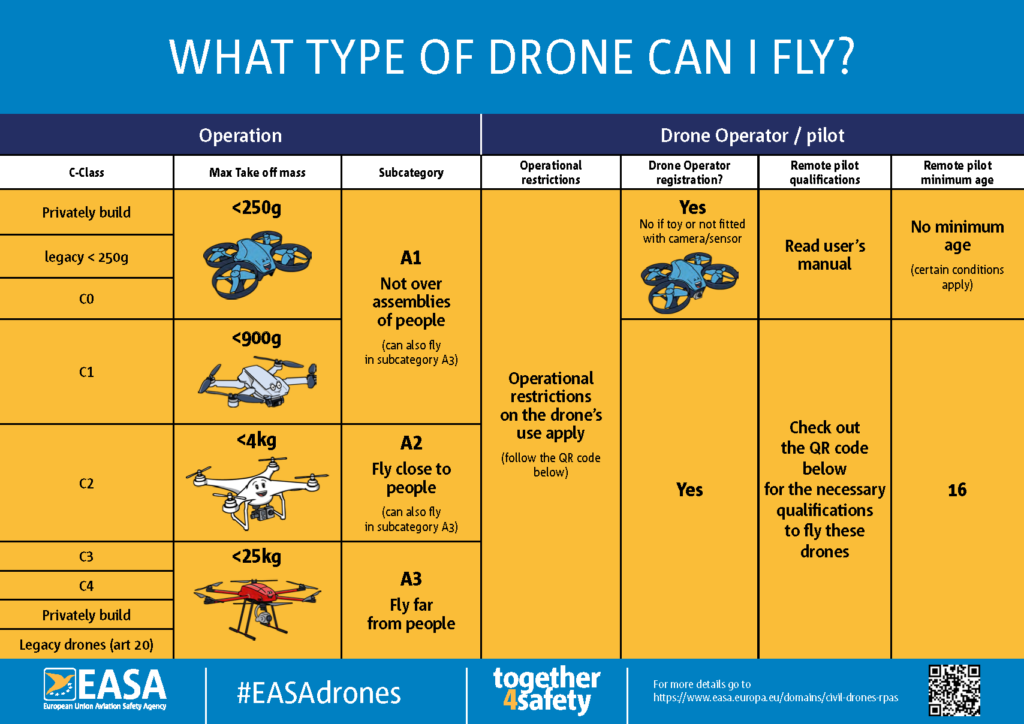
EASA Open Category diagram. Source: easa.europa.eu
Step 3 — Camera Specs That Actually Matter for Hobbyists
Drone marketing loves to lead with camera specs. Here’s what actually makes a difference in real-world footage.
Resolution and Frame Rate
For hobbyist use in 2026, the minimum worth buying is 4K at 30fps. Anything below that — 2.7K or 1080p — will look soft on any modern screen and leaves you no room for cropping in post.
If you plan to create slow-motion shots, look for 4K at 60fps or 1080p at 120fps. The DJI Mini 5 Pro shoots 4K at 60fps; the DJI Air 3S shoots 4K at 120fps — a significant step up.
Sensor Size — The Number That Moves the Needle Most
Larger sensors capture more light, which means better footage in low light and more natural depth of field. Sensor sizes in common hobbyist drones:
- 1/3-inch sensor: Entry-level. Acceptable in full sun, noisy indoors or at dusk.
- 1/2-inch sensor: Meaningful improvement. Most mid-range drones.
- 1/1.3-inch to 1-inch sensor: Excellent low-light performance. Found in the DJI Air 3S and DJI Mavic 4 Pro.
Stabilisation: Mechanical vs. Electronic
Mechanical gimbal stabilisation (3-axis) is non-negotiable for smooth video. Electronic Image Stabilisation (EIS) can supplement it but should not replace it.
Every drone on the comparison table above includes a 3-axis mechanical gimbal. If you’re looking at drones outside this list, verify this before buying — particularly any clone or budget brand drone under €200.
Manual Camera Controls
This matters more than most beginners expect. Auto mode handles itself, but learning to shoot in manual lets you control cinematic motion blur correctly using the 180-degree shutter rule. The full explanation is in our Manual Drone Camera Settings guide — worth reading before your first flight.
Step 4 — Flight Time, Wind Resistance, Noise & Safety Features
Reading the Flight Time Claim
Manufacturer flight times are tested in calm conditions with a fully charged battery at moderate speed. Real-world performance is typically 70–80% of the stated figure.
| Stated Flight Time | Expect in the Field |
|---|---|
| 20 minutes | ~14–16 minutes |
| 30 minutes | ~21–24 minutes |
| 38 minutes | ~26–30 minutes |
Budget for the lower number. Always bring at least two batteries.
Wind Resistance — Critical for Europe
Wind resistance is measured on a Beaufort scale. Most consumer drones handle up to Level 5 (29–38 km/h wind speed). The DJI Air 3S handles up to Level 7 — meaningfully better for exposed Alpine or coastal shooting.
In Southern Germany, the Föhn wind off the Alps can gust to 60+ km/h at exposed ridgelines. Knowing your drone’s limits matters.
Noise and Social Context
This one gets skipped in almost every guide, but it affects which drone you should choose. Flying near other people — at a family event, in a park, near a hiking trail — is a social situation. A louder drone draws attention, complaints, and sometimes confrontation.
The DJI Neo 2 (135g) and DJI Mini series are noticeably quieter than larger platforms. If you plan to fly near people regularly, size and noise level should factor into your decision. A smaller, quieter drone also makes it easier to shoot in residential areas where technically permitted but socially sensitive.
Obstacle Avoidance
Entry-level drones — including the DJI Mini 4K — have no obstacle avoidance. This is fine on open hillsides. It’s a liability in forests, around buildings, or anywhere branches or cables are present.
Omnidirectional obstacle avoidance (front, rear, side, up, and down sensors) starts appearing at the mid-range tier. For beginners who haven’t mastered manual stick control yet, it’s worth the premium.
💡 Pro Tip: Practice low-altitude hovering in open fields before attempting any complex manoeuvres. The Drone Flying Tutorial Masterclass walks through exactly this progression.
Step 5 — Ecosystem, Support & Longevity
Will This Drone Still Be Supported in Two Years?
This is the real future-proofing question, and most guides ignore it.
DJI has a strong track record of multi-year firmware support for its Mini and Air series. The Mini 3 Pro (released 2022) still receives updates in 2026. Spare parts — blades, battery chargers, gimbal covers — are widely stocked across European retailers and directly through DJI’s EU store.
For non-DJI brands, research part availability and firmware update history before buying. A drone that receives no firmware updates within 18 months of launch often signals an abandoned product line.
How to Tell If a Model Is About to Be Replaced
DJI typically refreshes its Mini series every 12–18 months. If a model is already 14–16 months old and rumours of a successor are circulating, it’s worth waiting or going one tier up. The comparison table in this article reflects the current 2026 lineup — check the Best Drones Buyer’s Guide for updates as new models release.
The DJI Ecosystem Advantage
DJI dominates the consumer drone market for a reason: the app (DJI Fly), controller options, and accessory ecosystem are all deeply integrated. If you’re a beginner, staying in the DJI ecosystem removes substantial friction — tutorials, community support, and accessories all align.
Controller Options to Know
- Phone-clip controller (RC-N1): Uses your smartphone as a screen. Cheapest bundle option. Works well but drains your phone battery.
- Dedicated screen controller (RC or RC2): Built-in 5.5-inch display. Far better in direct sunlight. Worth the €100–€150 bundle premium if you’re shooting outdoors regularly.
Intelligent Flight Modes
For hobbyists, automated flight modes accelerate the learning curve significantly:
- QuickShots (Dronie, Helix, Boomerang, Rocket): pre-programmed cinematic moves excellent for social media content
- MasterShots: automated multi-move sequence for a single subject — useful for real estate reveals
- ActiveTrack / Focus Track: subject tracking that keeps a person or vehicle centred automatically
These aren’t gimmicks. They produce results that take months to replicate manually.
Where to Go Next for Specific Recommendations
This checklist gives you the framework. For specific model recommendations by budget and use case, these are the right next stops:
- If the DJI Mini 5 Pro is on your shortlist → DJI Mini 5 Pro Review 2026 goes deep on the specs, real-world image quality, and who it’s actually for.
- If you want the best drone for your budget tier → Best Drones for Beginners 2026, Best Drones Under €500, or Best Drones Under €300 depending on where you land.
- If you want the full picture across all categories → Best Drones: The Complete Buyer’s Guide (2026) covers every tier, every use case, and is updated as new models release.
Once you’ve made your decision, the single most useful thing you can read before your first flight is the Drone Pre-Flight Checklist. A forgotten return-to-home altitude or an unchecked compass calibration is where most early crashes happen — not from bad flying, but from skipped steps.
Read Next on Aero Timelapse
Start here: → Best Drones: The Complete Buyer’s Guide (2026) — all drone categories, all use cases, one complete resource.
Buying guides by budget: → Best Drones for Beginners 2026 → Best Drones Under €500 Euro 2026 → Best Drones Under €300 Euro 2026
After you buy: → DJI Mini 5 Pro Review 2026 → Manual Drone Camera Settings → Drone Flying Tutorial Masterclass → The Complete Drone Videography Guide (2026)
Free tools: → ND Filter Calculator 🔧
FAQ — Drone Buying Checklist
What should I look for when buying a drone as a beginner?
A: Focus on five things in order: budget (including accessories), weight class (under 250g means no EU registration for recreational flying), camera quality (minimum 4K 30fps in 2026), real-world flight time (plan for 70–80% of the stated figure), and obstacle avoidance (strongly recommended for beginners). Don’t buy based on the drone spec sheet alone — apply this checklist to your actual situation first.
What is the best beginner drone in Europe in 2026?
For most beginners in the EU, the DJI Mini 5 Pro is the best overall choice — 4K at 60fps, a 1/1.28-inch sensor, omnidirectional obstacle avoidance, and roughly 25 minutes of real-world flight time. If budget is the primary concern, the DJI Mini 4K is the cleanest entry point under €330: it stays under 250g (no EU registration required for recreational use) and shoots genuine 4K video.
Do I need to register my drone in Germany?
In Germany, you need an EASA Operator ID if your drone weighs 250g or more. Registration costs €25.60 through the LBA (Luftfahrt-Bundesamt) portal and is valid across the EU. You also need a free A1/A3 competency certificate for open category flights above 250g. Drones under 250g flown recreationally in open areas have simpler requirements — which is why the DJI Mini 4 Pro (249g) and DJI Neo 2 (135g) are popular choices in Germany.
How much flight time do I actually get from a drone?
Expect 70–80% of the manufacturer’s stated figure in real conditions. A drone rated at 34 minutes gives you approximately 24–27 minutes in light wind at 15 km/h, less in cold weather. Always carry at least two batteries — plan for 20–25 usable minutes per battery as your working assumption.
Is the DJI Mini 5 Pro worth it over the Mini 4 Pro?
Yes, for most buyers in 2026. The Mini 5 Pro adds a larger sensor (1/1.28-inch vs. 1/1.3-inch), omnidirectional obstacle avoidance (the Mini 4 Pro has only front, rear, and upward sensing), and 4K at 60fps. The trade-off is weight — 299g vs. 249g — which crosses the EU 250g registration threshold. If staying under 250g is critical for your flying situations, the Mini 4 Pro remains the better choice. For everyone else, the Mini 5 Pro’s safety and image improvements justify the crossover. See the full breakdown in our DJI Mini 5 Pro Review.
Final Takeaway
Here’s the one thing to do right now: take the five steps in this drone buying checklist and apply them in order to the model you’re considering. Budget first. Weight class and EU regulations second. Then camera, flight time, and ecosystem. You’ll rule out at least one option immediately — and the right choice becomes obvious.
Once you’ve decided, the very next tab to open is the Drone Pre-Flight Checklist. Most first-flight mistakes don’t happen in the air. They happen in the two minutes before takeoff.
Your first flight is going to be fine.
Dipon is a drone and timelapse cinematographer based in Ulm, Germany, with over 15 years of experience turning real spaces and projects into cinematic visuals. With a background in digital marketing, every shot is planned with a clear purpose — where it will appear, who will see it, and what it should help them decide.
You May Also Like

How to Shoot a Little Planet Photo With a Drone
Best Drones for Beginners (2026): Safe, Easy Picks + Buying Guide
Why Sensor Size Matters When You’re Buying a Drone
How Weather Affects Timelapse & Drone Shoots
DJI Lito X1 vs Mini 5 Pro: Which Ultralight Drone Belongs in Your Camera Bag?
DJI Mavic 4 Pro vs DJI Air 3S
DJI Air 3S Review: The Sweet-Spot Drone for Creators and Professionals
DJI Mavic 4 Pro Review: Is It Worth It for Professional Work? (2026)

Best Prime Week Drone Deals for Creators and Beginners
Drone Laws & Regulations — The Complete Legal Guide for EU Pilots (2026)

Best Timelapse Cameras Under €1,000 in 2026

DJI Lito X1 Review: The Ultimate Pocket-Sized B-Cam for Creators?
Need help capturing aerials for your next project but not ready to invest in the gear yet? Check out our Drone Videography to see how Aero Timelapse Studio can help elevate your production.